henry needs $4616 for a future project. he can invest $4000 now at an annual rate of 9.8%, compounded…
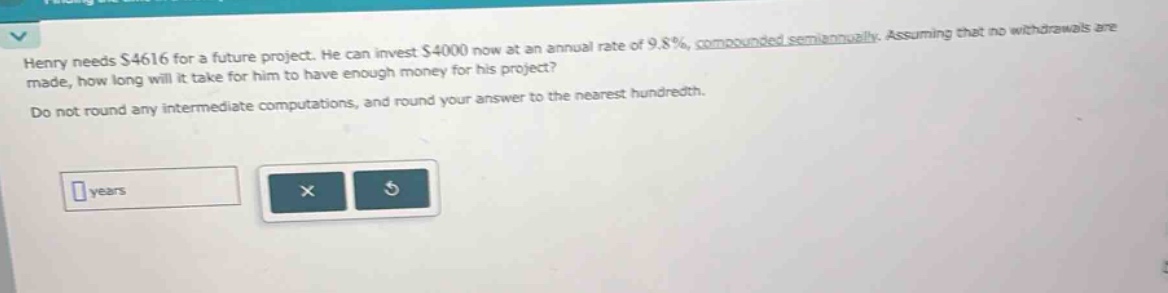
henry needs $4616 for a future project. he can invest $4000 now at an annual rate of 9.8%, compounded semiannually. assuming that no withdrawals are made, how long will it take for him to have enough money for his project? do not round any intermediate computations, and round your answer to the nearest hundredth.
Answer
Explanation:
Step1: Identify compound - interest formula
The compound - interest formula is $A = P(1+\frac{r}{n})^{nt}$, where $A$ is the final amount, $P$ is the principal amount, $r$ is the annual interest rate (in decimal form), $n$ is the number of times compounded per year, and $t$ is the number of years. Given $P = 4000$, $A=4616$, $r = 0.098$ (since $9.8%=0.098$), and $n = 2$ (compounded semiannually). Substitute these values into the formula: $4616=4000(1 +\frac{0.098}{2})^{2t}$.
Step2: Simplify the equation
First, simplify $1+\frac{0.098}{2}=1 + 0.049=1.049$. The equation becomes $\frac{4616}{4000}=(1.049)^{2t}$. Since $\frac{4616}{4000}=1.154$, we have $1.154=(1.049)^{2t}$.
Step3: Take the natural logarithm of both sides
$\ln(1.154)=\ln((1.049)^{2t})$. Using the property of logarithms $\ln(a^b)=b\ln(a)$, we get $\ln(1.154)=2t\ln(1.049)$.
Step4: Solve for $t$
We know that $\ln(1.154)\approx0.143$ and $\ln(1.049)\approx0.048$. So, $0.143 = 2t\times0.048$. First, simplify the right - hand side: $2t\times0.048 = 0.096t$. Then, $t=\frac{0.143}{0.096}\approx1.49$.
Answer:
$1.49$