about 5% of hourly - paid workers in a region earn the prevailing minimum wage or less. a grocery chain…
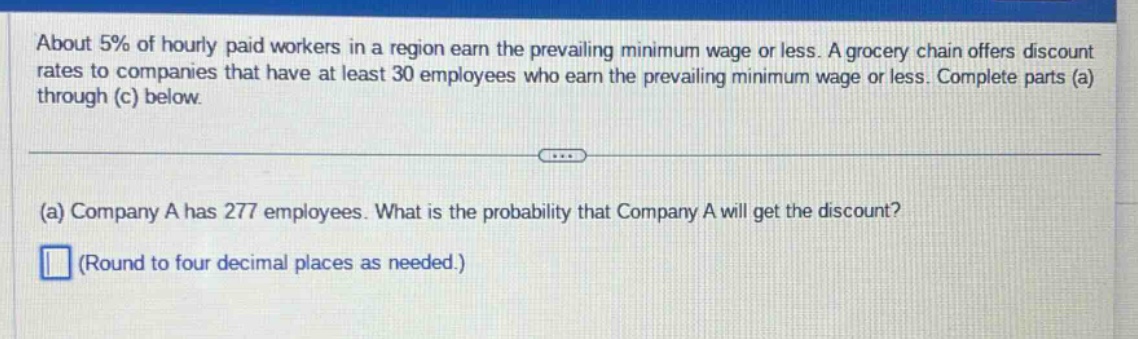
about 5% of hourly - paid workers in a region earn the prevailing minimum wage or less. a grocery chain offers discount rates to companies that have at least 30 employees who earn the prevailing minimum wage or less. complete parts (a) through (c) below.\n(a) company a has 277 employees. what is the probability that company a will get the discount?\n(round to four decimal places as needed.)
Answer
Explanation:
Step1: Identify the distribution
This is a binomial - like problem. Let (X) be the number of employees who earn the minimum wage or less. (n = 277) (number of employees in Company A), (p=0.05). Since (np = 277\times0.05=13.85) and (n(1 - p)=277\times(1 - 0.05)=277\times0.95 = 263.15), we can approximate the binomial distribution with a normal distribution. The mean of the normal - approximation (\mu=np=277\times0.05 = 13.85) and the standard deviation (\sigma=\sqrt{np(1 - p)}=\sqrt{277\times0.05\times(1 - 0.05)}=\sqrt{13.85\times0.95}\approx3.63).
Step2: Apply the continuity correction
We want (P(X\geq30)). For the normal approximation to the binomial, when using the normal distribution (N(\mu,\sigma^{2})) to approximate a binomial distribution for (P(X\geq k)), we find (P\left(Z\geq\frac{k - 0.5-\mu}{\sigma}\right)). Here, (k = 30), so we calculate (z=\frac{30 - 0.5-13.85}{3.63}=\frac{15.65}{3.63}\approx4.31).
Step3: Find the probability
We know that (P(Z\geq4.31)=1 - P(Z < 4.31)). Looking up in the standard normal table, (P(Z < 4.31)\approx1). So (P(Z\geq4.31)=1 - 1=0).
Answer:
0.0000