jahnae opens a savings account and deposits $2,000. the account earns 5% interest, compounded quarterly. how…
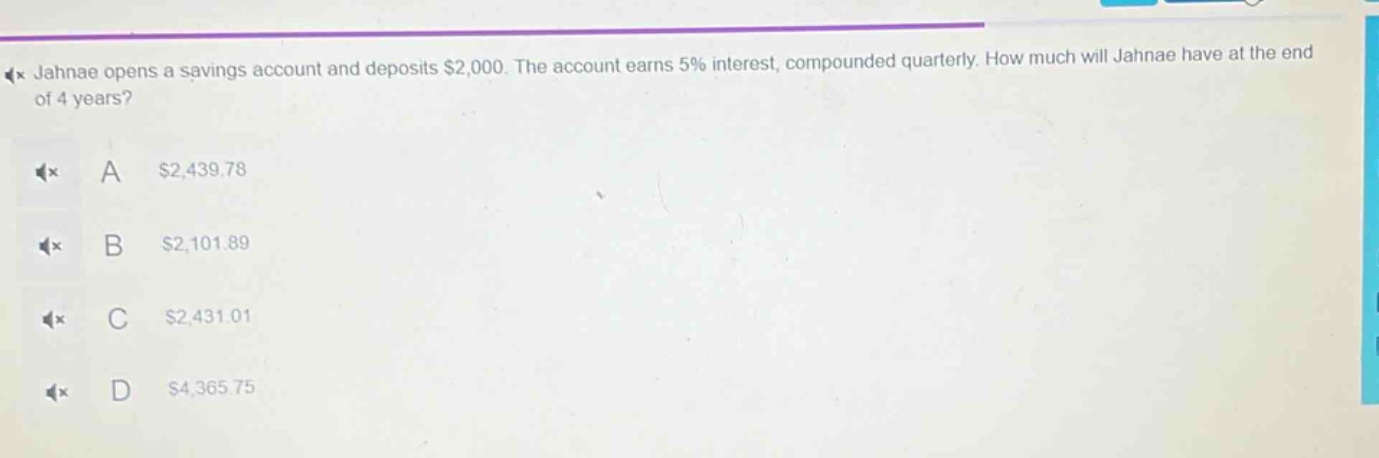
jahnae opens a savings account and deposits $2,000. the account earns 5% interest, compounded quarterly. how much will jahnae have at the end of 4 years? a $2,439.78 b $2,101.89 c $2,431.01 d $4,365.75
Answer
Explanation:
Step1: Identify compound - interest formula
The compound - interest formula is $A = P(1+\frac{r}{n})^{nt}$, where $P$ is the principal amount, $r$ is the annual interest rate (in decimal form), $n$ is the number of times interest is compounded per year, and $t$ is the number of years.
Step2: Convert values to appropriate form
Given $P=$2000$, $r = 0.05$ (since $5%=0.05$), $n = 4$ (compounded quarterly), and $t = 4$ years.
Step3: Substitute values into formula
$A=2000(1 +\frac{0.05}{4})^{4\times4}=2000(1 + 0.0125)^{16}$.
Step4: Calculate the value inside the parentheses
$1+0.0125=1.0125$.
Step5: Calculate the exponent part
$(1.0125)^{16}\approx1.2198895$.
Step6: Calculate the final amount
$A = 2000\times1.2198895=$2439.779\approx$2439.78$.
Answer:
A. $2,439.78