jakes cameras purchased a digital camera at a wholesale cost of $80. they marked up the price 50 percent…
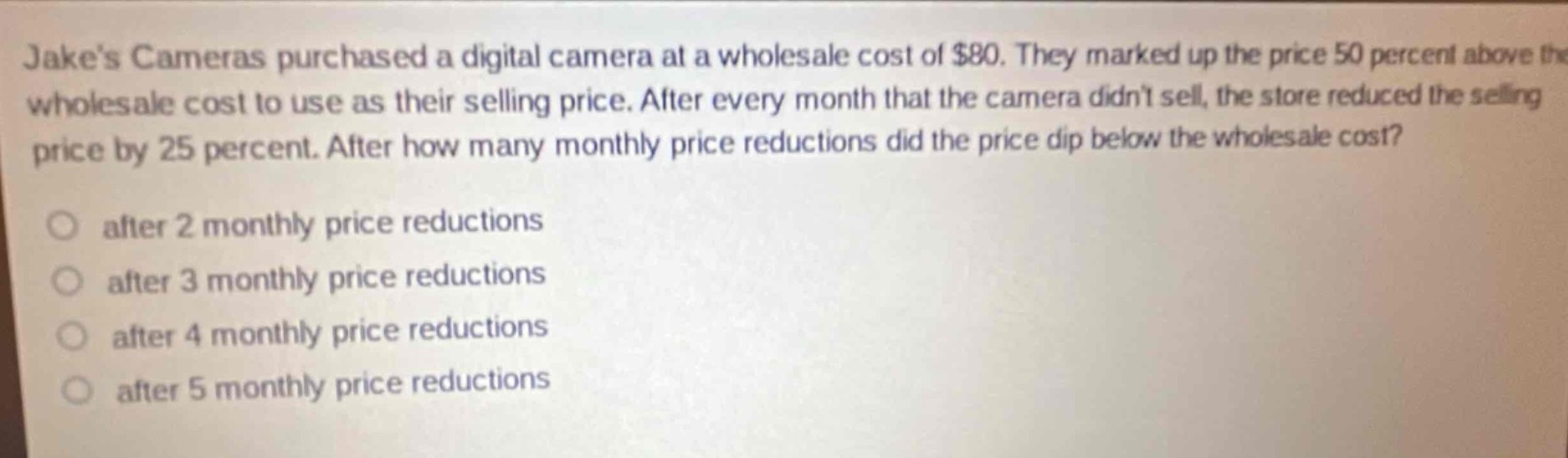
jakes cameras purchased a digital camera at a wholesale cost of $80. they marked up the price 50 percent above the wholesale cost to use as their selling price. after every month that the camera didnt sell, the store reduced the selling price by 25 percent. after how many monthly price reductions did the price dip below the wholesale cost?\n\nafter 2 monthly price reductions\nafter 3 monthly price reductions\nafter 4 monthly price reductions\nafter 5 monthly price reductions
Answer
Explanation:
Step1: Calcular el precio de venta inicial
El costo minorista es de $80. El aumento es del 50%, entonces el precio de venta inicial $P_0$ es $P_0=80\times(1 + 0.5)=80\times1.5 = 120$.
Step2: Escribir la fórmula para el precio después de $n$ reducciones
Después de cada reducción del 25%, el precio $P_n$ se calcula como $P_n=P_0\times(1 - 0.25)^n=120\times(0.75)^n$.
Step3: Encontrar $n$ tal que $P_n<80$
Para $n = 2$: $P_2=120\times(0.75)^2=120\times0.5625 = 67.5<80$.
Answer:
A. after 2 monthly price reductions