juan is a single taxpayer. he earned $45,000 in ordinary taxable income this year and has $10,000 in capital…
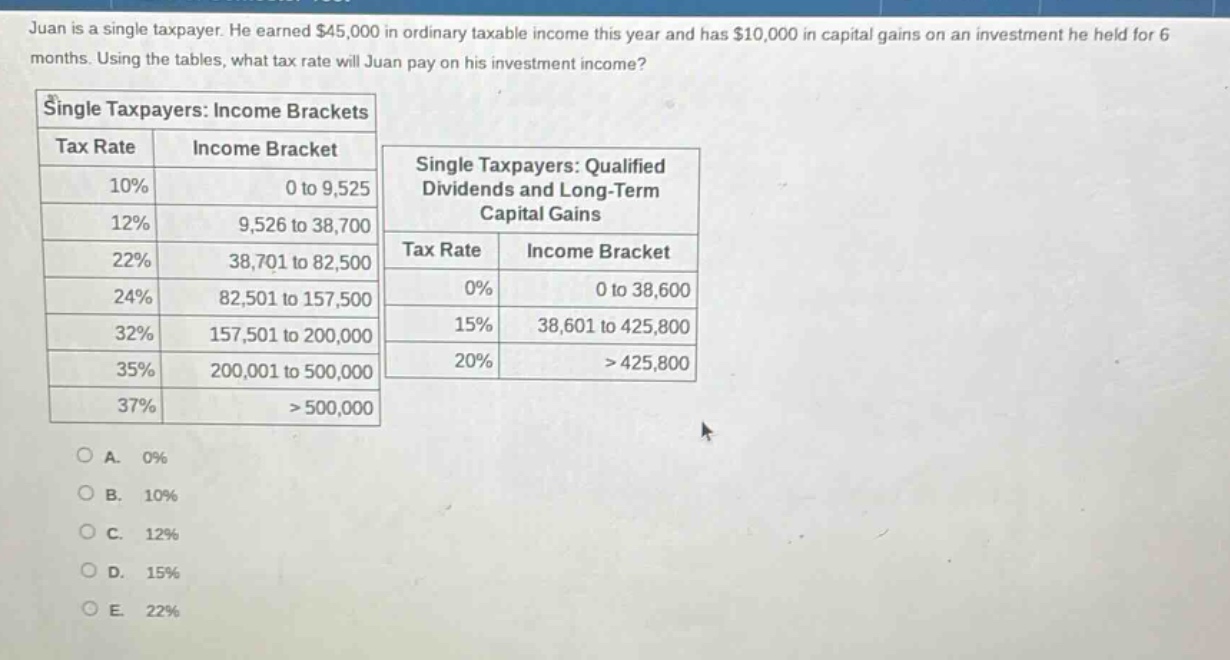
juan is a single taxpayer. he earned $45,000 in ordinary taxable income this year and has $10,000 in capital gains on an investment he held for 6 months. using the tables, what tax rate will juan pay on his investment income?\nsingle taxpayers: income brackets\n| tax rate | income bracket |\n| ---- | ---- |\n| 10% | 0 to 9,525 |\n| 12% | 9,526 to 38,700 |\n| 22% | 38,701 to 82,500 |\n| 24% | 82,501 to 157,500 |\n| 32% | 157,501 to 200,000 |\n| 35% | 200,001 to 500,000 |\n| 37% | > 500,000 |\nsingle taxpayers: qualified dividends and long - term capital gains\n| tax rate | income bracket |\n| ---- | ---- |\n| 0% | 0 to 38,600 |\n| 15% | 38,601 to 425,800 |\n| 20% | > 425,800 |\na. 0%\nb. 10%\nc. 12%\nd. 15%\ne. 22%
Answer
Answer:
E. 22%
Explanation:
Step1: Identify investment type
The investment was held for 6 months, so it's a short - term capital gain. Short - term capital gains are taxed as ordinary income.
Step2: Locate income bracket
Juan's ordinary taxable income is $45,000. His total ordinary income including the $10,000 short - term capital gain is $45,000 + $10,000=$55,000.
Step3: Determine tax rate
From the single taxpayers' income brackets table, for an income of $55,000 (in the range of $38,701 to $82,500), the tax rate is 22%.