keisha needs $12,276 for a future project. she can invest $6000 now at an annual rate of 5%, compounded…
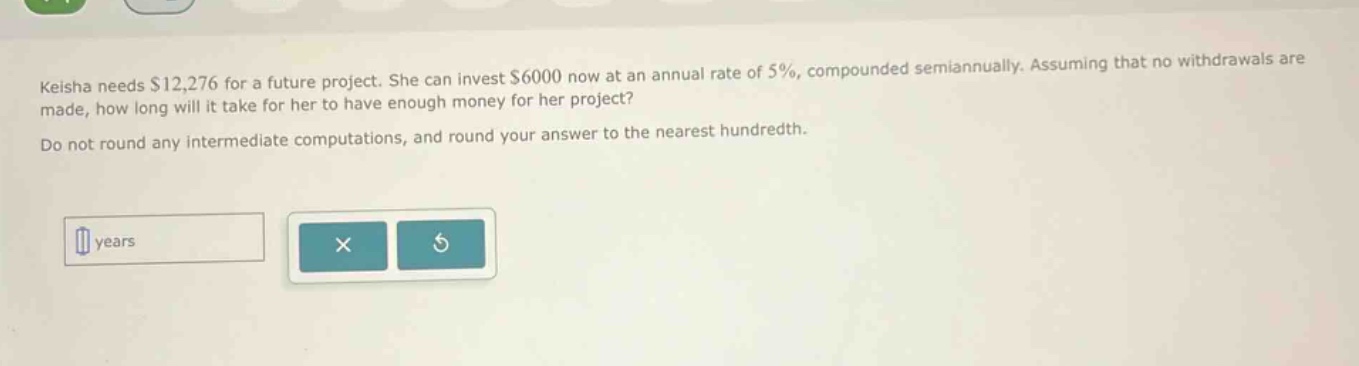
keisha needs $12,276 for a future project. she can invest $6000 now at an annual rate of 5%, compounded semiannually. assuming that no withdrawals are made, how long will it take for her to have enough money for her project? do not round any intermediate computations, and round your answer to the nearest hundredth. years
Answer
Explanation:
Step1: Escribir la fórmula de interés compuesto
La fórmula para el interés compuesto es ( A = P\left(1+\frac{r}{n}\right)^{nt} ), donde ( A ) es el monto final (( A = 12276 )), ( P ) es la inversión inicial (( P=6000 )), ( r ) es la tasa de interés anual ( ( r = 0.05 )), ( n ) es el número de veces que se compone el interés por año (( n = 2 ) ya que es semianual), y ( t ) es el tiempo en años (lo que se busca). Sustituyendo los valores: ( 12276=6000\left(1 +\frac{0.05}{2}\right)^{2t} ).
Step2: Simplificar la ecuación
Dividir ambos lados por ( 6000 ): ( \frac{12276}{6000}=\left(1 + 0.025\right)^{2t} ). ( 2.046=(1.025)^{2t} ).
Step3: Aplicar logaritmo
Tomar logaritmo natural de ambos lados: ( \ln(2.046)=\ln\left((1.025)^{2t}\right) ). Usar la propiedad ( \ln(a^b)=b\ln(a) ): ( \ln(2.046)=2t\ln(1.025) ).
Step4: Resolver para ( t )
Primero, calcular ( \ln(2.046)\approx0.716 ) y ( \ln(1.025)\approx0.0247 ). Entonces, ( 0.716 = 2t\times0.0247 ). ( 2t=\frac{0.716}{0.0247}\approx29.0 ). ( t=\frac{29.0}{2}=14.5 ).
Answer:
( 14.50 )