leticia invests $200 at 5% interest. if y represents the amount of money after x time periods, which…
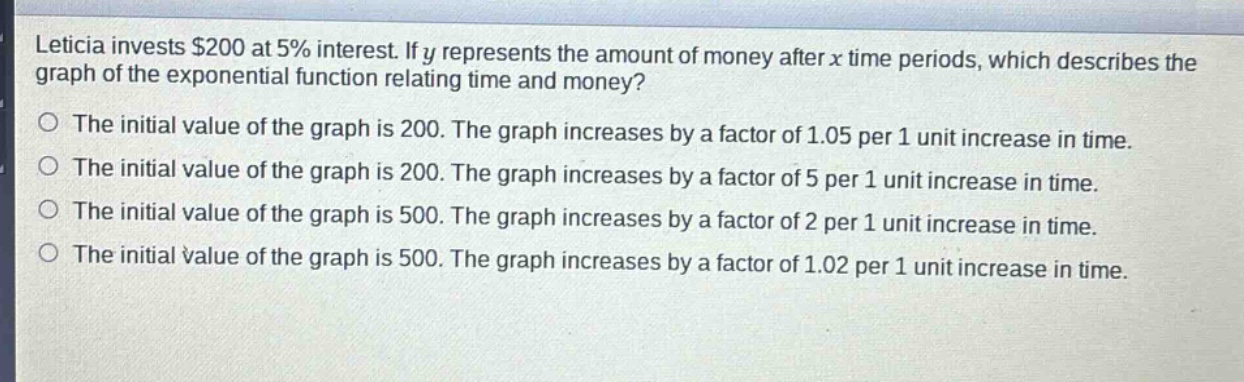
leticia invests $200 at 5% interest. if y represents the amount of money after x time periods, which describes the graph of the exponential function relating time and money?\no the initial value of the graph is 200. the graph increases by a factor of 1.05 per 1 unit increase in time.\no the initial value of the graph is 200. the graph increases by a factor of 5 per 1 unit increase in time.\no the initial value of the graph is 500. the graph increases by a factor of 2 per 1 unit increase in time.\no the initial value of the graph is 500. the graph increases by a factor of 1.02 per 1 unit increase in time.
Answer
Explanation:
Step1: Recall compound - interest formula
The formula for compound - interest is $y = a(1 + r)^x$, where $a$ is the initial amount, $r$ is the interest rate per time period, and $x$ is the number of time periods. Here, $a = 200$ and $r=0.05$. So the function is $y = 200(1 + 0.05)^x=200\times1.05^x$.
Step2: Analyze the initial value and growth factor
When $x = 0$, $y=200\times1.05^0 = 200$, so the initial value of the graph (when $x = 0$) is 200. The base of the exponential function is 1.05, which means the graph increases by a factor of 1.05 per 1 - unit increase in time.
Answer:
The initial value of the graph is 200. The graph increases by a factor of 1.05 per 1 unit increase in time.