melissa deposits $30,000 into an account that pays 2% interest per year, compounded annually. greg deposits…
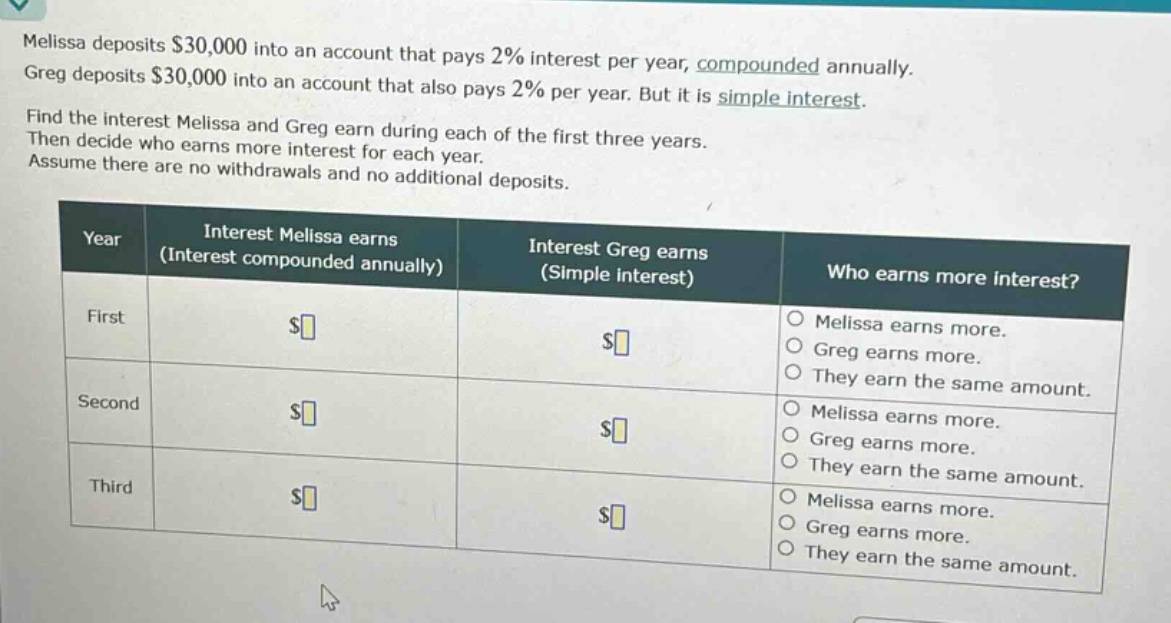
melissa deposits $30,000 into an account that pays 2% interest per year, compounded annually. greg deposits $30,000 into an account that also pays 2% per year. but it is simple interest. find the interest melissa and greg earn during each of the first three years. then decide who earns more interest for each year. assume there are no withdrawals and no additional deposits. year interest melissa earns (interest compounded annually) interest greg earns (simple interest) who earns more interest? first $ $ melissa earns more. greg earns more. they earn the same amount. second $ $ melissa earns more. greg earns more. they earn the same amount. third $ $ melissa earns more. greg earns more. they earn the same amount.
Answer
Explanation:
Step1: Calculate simple - interest formula
The simple - interest formula is $I = Prt$, where $P$ is the principal amount, $r$ is the annual interest rate (in decimal form), and $t$ is the time in years. Given $P=$30000$, $r = 0.02$. For any year $t$, Greg's simple interest $I_G=30000\times0.02\times t$.
Step2: Calculate compound - interest formula
The compound - interest formula is $A = P(1 + r)^t$, where $A$ is the amount of money in the account after $t$ years, $P$ is the principal amount, $r$ is the annual interest rate (in decimal form), and $t$ is the number of years. The interest earned $I_M=P(1 + r)^t−P$. For $P = 30000$, $r=0.02$.
First - year calculations
Greg's interest
$I_G=30000\times0.02\times1 = 600$
Melissa's interest
$A = 30000\times(1 + 0.02)^1=30000\times1.02 = 30600$, $I_M=30600 - 30000=600$ They earn the same amount.
Second - year calculations
Greg's interest
$I_G=30000\times0.02\times1 = 600$
Melissa's interest
$A = 30000\times(1 + 0.02)^2=30000\times1.02^2=30000\times1.0404 = 31212$, $I_M=31212 - 30600 = 612$ Melissa earns more.
Third - year calculations
Greg's interest
$I_G=30000\times0.02\times1 = 600$
Melissa's interest
$A = 30000\times(1 + 0.02)^3=30000\times1.02^3=30000\times1.061208 = 31836.24$, $I_M=31836.24 - 31212=624.24$ Melissa earns more.
Answer:
| Year | Interest Melissa earns (Interest compounded annually) | Interest Greg earns (Simple interest) | Who earns more interest? |
|---|---|---|---|
| First | $$600$ | $$600$ | They earn the same amount. |
| Second | $$612$ | $$600$ | Melissa earns more. |
| Third | $$624.24$ | $$600$ | Melissa earns more. |