mr. jimenez deposited money into an account in which interest is compounded quarterly at a rate of 2.6%. how…
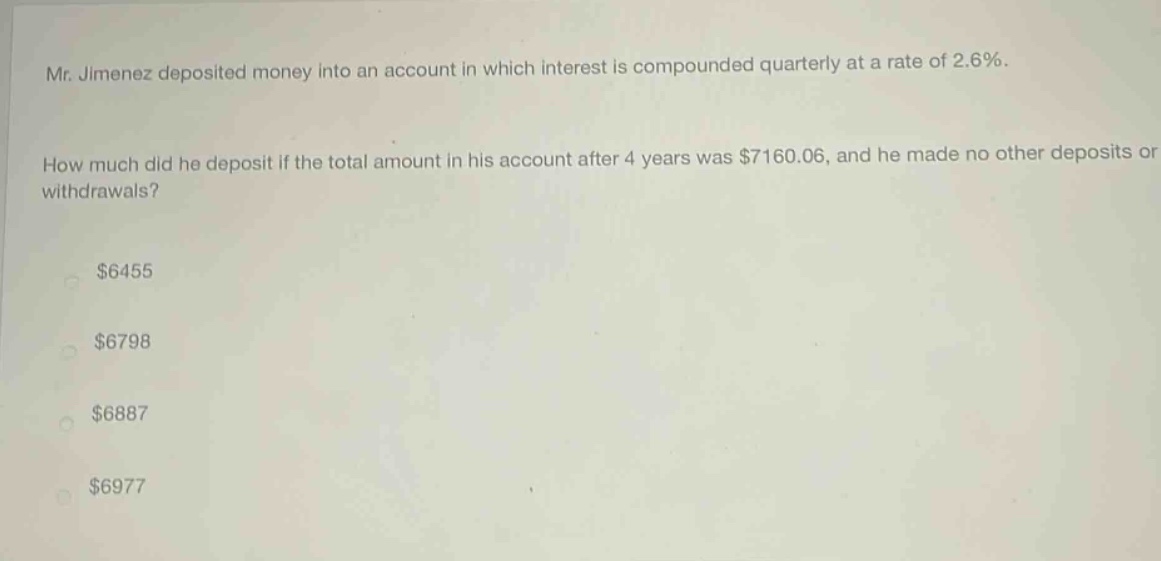
mr. jimenez deposited money into an account in which interest is compounded quarterly at a rate of 2.6%. how much did he deposit if the total amount in his account after 4 years was $7160.06, and he made no other deposits or withdrawals? $6455 $6798 $6887 $6977
Answer
Explanation:
Step1: Identify compound - interest formula
The compound - interest formula is $A = P(1+\frac{r}{n})^{nt}$, where $A$ is the final amount, $P$ is the principal (initial deposit), $r$ is the annual interest rate (in decimal), $n$ is the number of times interest is compounded per year, and $t$ is the number of years. Given $A=$7160.06$, $r = 0.026$ (since $2.6%=0.026$), $n = 4$ (compounded quarterly), and $t = 4$. We need to solve for $P$, so $P=\frac{A}{(1 +\frac{r}{n})^{nt}}$.
Step2: Substitute values into the formula
First, calculate $(1+\frac{r}{n})^{nt}$: $\frac{r}{n}=\frac{0.026}{4}=0.0065$ $nt=4\times4 = 16$ $(1+\frac{r}{n})^{nt}=(1 + 0.0065)^{16}$ Using a calculator, $(1 + 0.0065)^{16}\approx1.10922$. Then, $P=\frac{7160.06}{1.10922}\approx6455$.
Answer:
$6455$