mr. valdez puts $10,000 in a retirement account and does not make any deposits or withdrawals. the table…
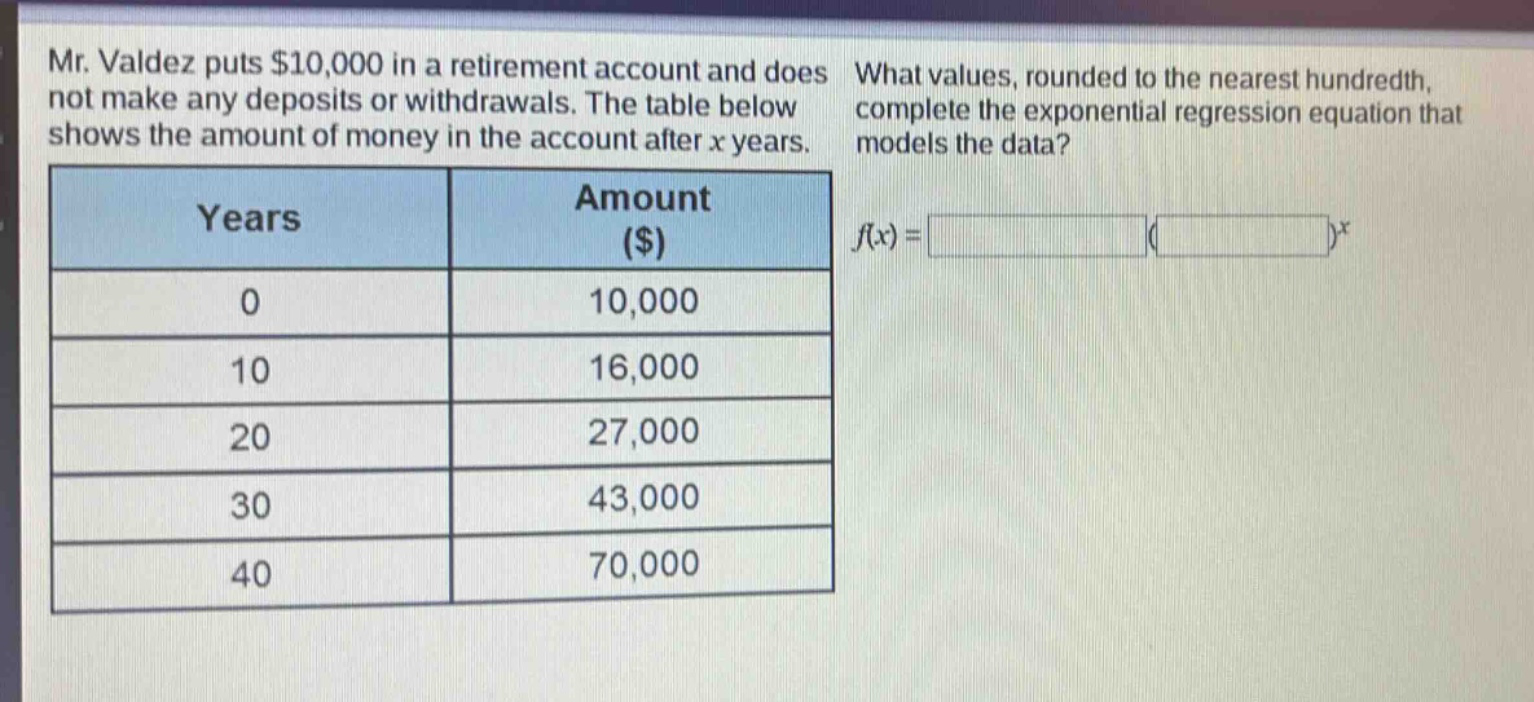
mr. valdez puts $10,000 in a retirement account and does not make any deposits or withdrawals. the table below shows the amount of money in the account after x years. what values, rounded to the nearest hundredth, complete the exponential regression equation that models the data?\n| years | amount ($) |\n| ---- | ---- |\n| 0 | 10,000 |\n| 10 | 16,000 |\n| 20 | 27,000 |\n| 30 | 43,000 |\n| 40 | 70,000 |\nf(x) = ( )^x
Answer
Explanation:
Step1: Recall exponential - function form
The general form of an exponential function is $f(x)=a(b)^{x}$, where $a$ is the initial value and $b$ is the growth factor. When $x = 0$, $f(0)=a(b)^{0}=a$.
Step2: Find the value of $a$
From the table, when $x = 0$, $f(0)=10000$. So, $a = 10000$.
Step3: Find the value of $b$
We know that when $x = 10$, $f(10)=16000$. Substitute $a = 10000$, $x = 10$ into $f(x)=a(b)^{x}$: $16000=10000(b)^{10}$. First, divide both sides by 10000: $\frac{16000}{10000}=b^{10}$, so $1.6=b^{10}$. Then, take the 10 - th root of both sides: $b = 1.6^{\frac{1}{10}}\approx1.049$.
Answer:
$f(x)=10000(1.05)^{x}$