how much money should be deposited today in an account that earns 2.5% compounded monthly so that it will…
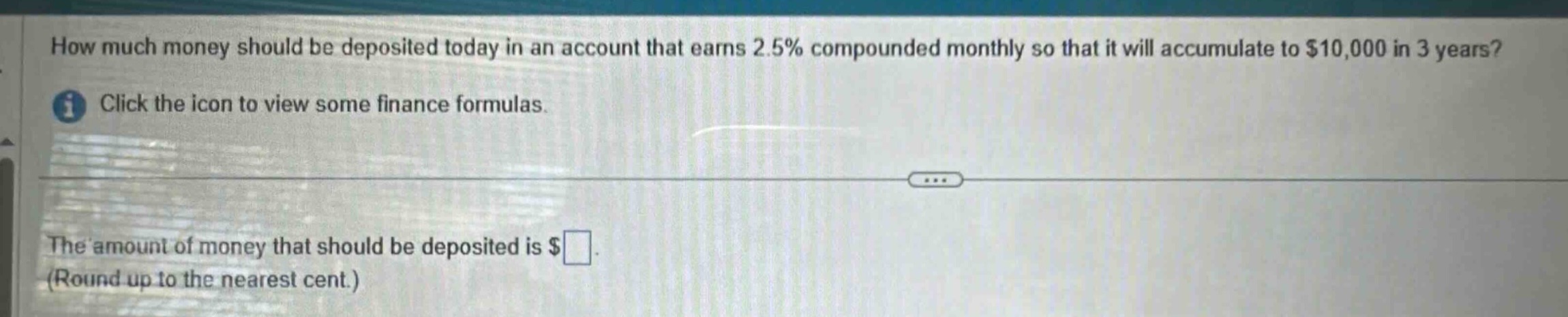
how much money should be deposited today in an account that earns 2.5% compounded monthly so that it will accumulate to $10,000 in 3 years? click the icon to view some finance formulas. the amount of money that should be deposited is $ (round up to the nearest cent.)
Answer
Explanation:
Step1: Identify the compound - interest formula
The compound - interest formula for present value $P$ is $P=\frac{A}{(1 + \frac{r}{n})^{nt}}$, where $A$ is the future value, $r$ is the annual interest rate (in decimal form), $n$ is the number of times compounded per year, and $t$ is the number of years.
Step2: Convert the given values to the appropriate form
Given $A = 10000$, $r=0.025$ (since $2.5%=0.025$), $n = 12$ (compounded monthly), and $t = 3$.
Step3: Substitute the values into the formula
$P=\frac{10000}{(1+\frac{0.025}{12})^{12\times3}}$. First, calculate the value inside the parentheses: $\frac{0.025}{12}\approx0.00208333$, then $1+\frac{0.025}{12}=1 + 0.00208333=1.00208333$. Next, calculate the exponent: $12\times3 = 36$. So, $(1+\frac{0.025}{12})^{12\times3}=(1.00208333)^{36}$. Using a calculator, $(1.00208333)^{36}\approx1.0778847$. Then, $P=\frac{10000}{1.0778847}\approx9277.07$.
Answer:
$9277.07$