nolan began a savings account three years ago. he invested $100 at a 2% interest rate according to the…
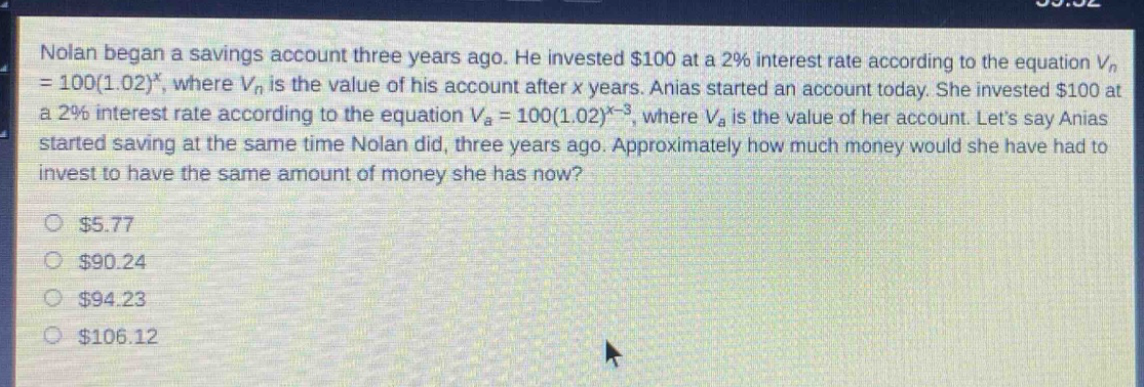
nolan began a savings account three years ago. he invested $100 at a 2% interest rate according to the equation $v_{n}=100(1.02)^{x}$, where $v_{n}$ is the value of his account after $x$ years. anias started an account today. she invested $100 at a 2% interest rate according to the equation $v_{a}=100(1.02)^{x - 3}$, where $v_{a}$ is the value of her account. lets say anias started saving at the same time nolan did, three years ago. approximately how much money would she have had to invest to have the same amount of money she has now?\n\n$5.77\n\n$90.24\n\n$94.23\n\n$106.12
Answer
Answer:
C. $94.23
Explanation:
Step1: Let $x = 3$ for Anias' current situation
Anias' current value formula is $V_a=100(1.02)^{x - 3}$. When $x = 3$, $V_a=100(1.02)^{3 - 3}=100(1.02)^{0}=100$.
Step2: Set up the compound - interest formula for the initial investment
We want to find the initial investment $P$ such that if Anias started 3 years ago with an interest rate of 2% compounded annually, after 3 years she would have the same amount as she has now. The compound - interest formula is $A = P(1 + r)^t$, where $A$ is the final amount, $P$ is the principal (initial investment), $r$ is the annual interest rate, and $t$ is the number of years. We know $A = 100$, $r=0.02$, and $t = 3$. So, $100=P(1 + 0.02)^3$.
Step3: Solve for $P$
We can rewrite the equation as $P=\frac{100}{(1.02)^3}$. Calculate $(1.02)^3=1.02\times1.02\times1.02 = 1.061208$. Then $P=\frac{100}{1.061208}\approx94.23$.