note: please make sure to properly format your answers. all dollar figures in the answers need to include…
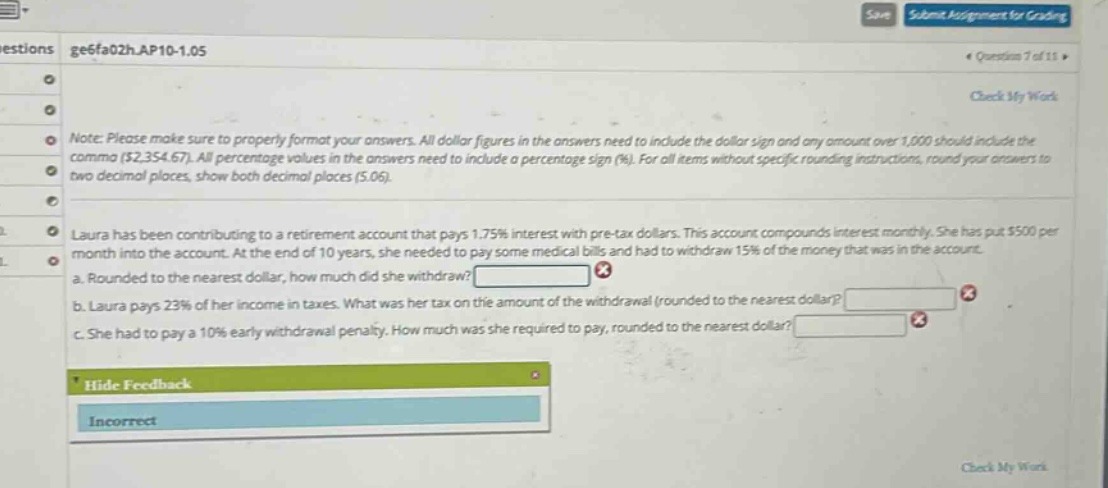
note: please make sure to properly format your answers. all dollar figures in the answers need to include the dollar sign and any amount over 1,000 should include the comma ($2,354.67). all percentage values in the answers need to include a percentage sign (%). for all items without specific rounding instructions, round your answers to two decimal places, show both decimal places (5.06). laura has been contributing to a retirement account that pays 1.75% interest with pre - tax dollars. this account compounds interest monthly. she has put $500 per month into the account. at the end of 10 years, she needed to pay some medical bills and had to withdraw 15% of the money that was in the account. a. rounded to the nearest dollar, how much did she withdraw? b. laura pays 23% of her income in taxes. what was her tax on the amount of the withdrawal (rounded to the nearest dollar)? c. she had to pay a 10% early withdrawal penalty. how much was she required to pay, rounded to the nearest dollar?
Answer
Explanation:
Step1: Calculate the future - value of the annuity
The formula for the future - value of an ordinary annuity is $FVA = P\times\frac{(1 + \frac{r}{n})^{nt}-1}{\frac{r}{n}}$, where $P=$500$ (monthly payment), $r = 0.0175$ (annual interest rate), $n = 12$ (number of compounding periods per year), and $t = 10$ (number of years). $FVA=500\times\frac{(1+\frac{0.0175}{12})^{12\times10}-1}{\frac{0.0175}{12}}$ First, calculate the exponent: $(1+\frac{0.0175}{12})^{12\times10}=(1 + 0.00145833)^{120}$. Using a calculator, $(1 + 0.00145833)^{120}\approx1.19677$. Then, $FVA = 500\times\frac{1.19677 - 1}{0.00145833}=500\times\frac{0.19677}{0.00145833}\approx500\times134.93\approx$67465$.
Step2: Calculate the withdrawal amount
She withdraws 15% of the money in the account. So the withdrawal amount $W=0.15\times67465=$10120$.
Step3: Calculate the tax on the withdrawal
She pays 23% tax on the withdrawal. Tax amount $T = 0.23\times10120=$2328$.
Step4: Calculate the early - withdrawal penalty
The early - withdrawal penalty is 10% of the withdrawal amount. Penalty amount $P_{en}=0.1\times10120=$1012$.
Answer:
a. $$10120$ b. $$2328$ c. $$1012$