number five\njohn deposited $600 into his bank account. it earns 3% annually and is compounded…
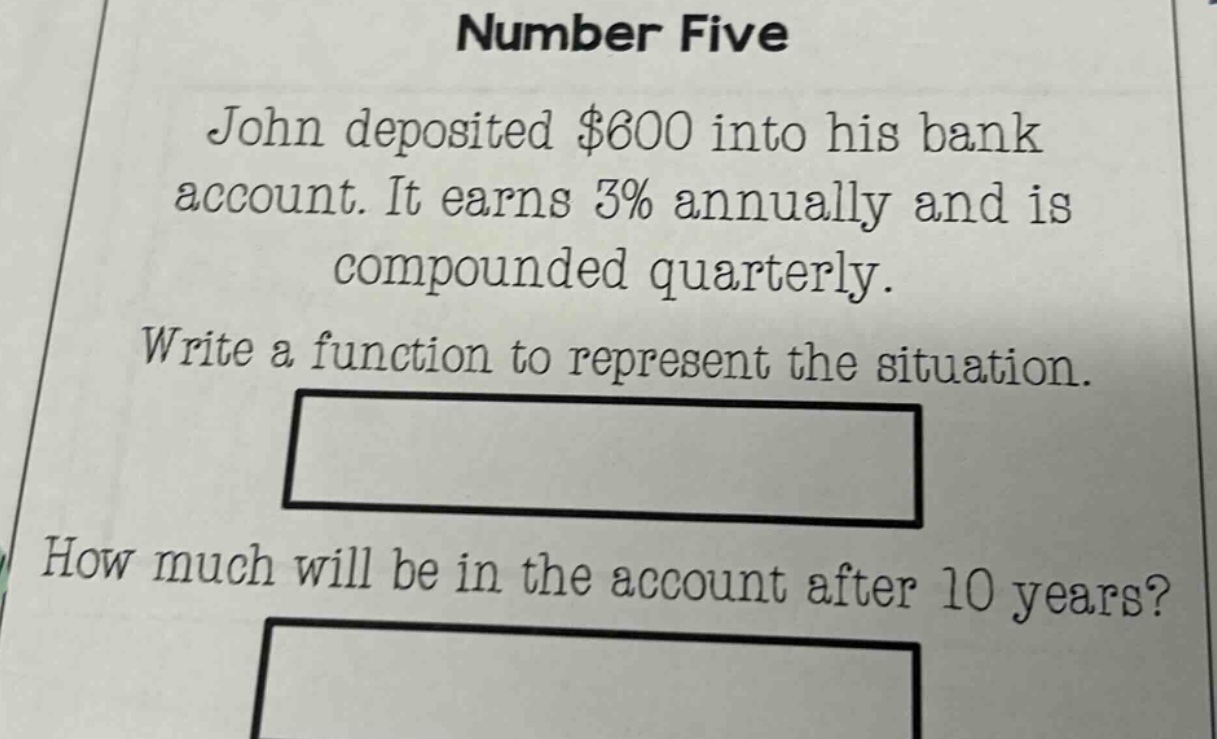
number five\njohn deposited $600 into his bank account. it earns 3% annually and is compounded quarterly.\nwrite a function to represent the situation.\nhow much will be in the account after 10 years?
Answer
Explanation:
Step1: Identify compound - interest formula
The compound - interest formula is $A(t)=P(1 +\frac{r}{n})^{nt}$, where $P$ is the principal amount, $r$ is the annual interest rate (in decimal form), $n$ is the number of times compounded per year, and $t$ is the number of years.
Step2: Determine the values of $P$, $r$, and $n$
Given $P = 600$, $r=0.03$ (since $3%=0.03$), and $n = 4$ (compounded quarterly). The function representing the situation is $A(t)=600(1+\frac{0.03}{4})^{4t}$.
Step3: Calculate the amount after 10 years
Substitute $t = 10$ into the formula $A(t)=600(1+\frac{0.03}{4})^{4t}$. First, calculate the value inside the parentheses: $1+\frac{0.03}{4}=1 + 0.0075=1.0075$. Then, $4t=4\times10 = 40$. So $A(10)=600\times(1.0075)^{40}$. Using a calculator, $(1.0075)^{40}\approx1.34835$ and $A(10)=600\times1.34835 = 809.01$.
Answer:
Function: $A(t)=600(1+\frac{0.03}{4})^{4t}$ Amount after 10 years: $$809.01$