option 1: compounding annually with no fee. option 2: compounding monthly with a $1 annual fee. emma puts…
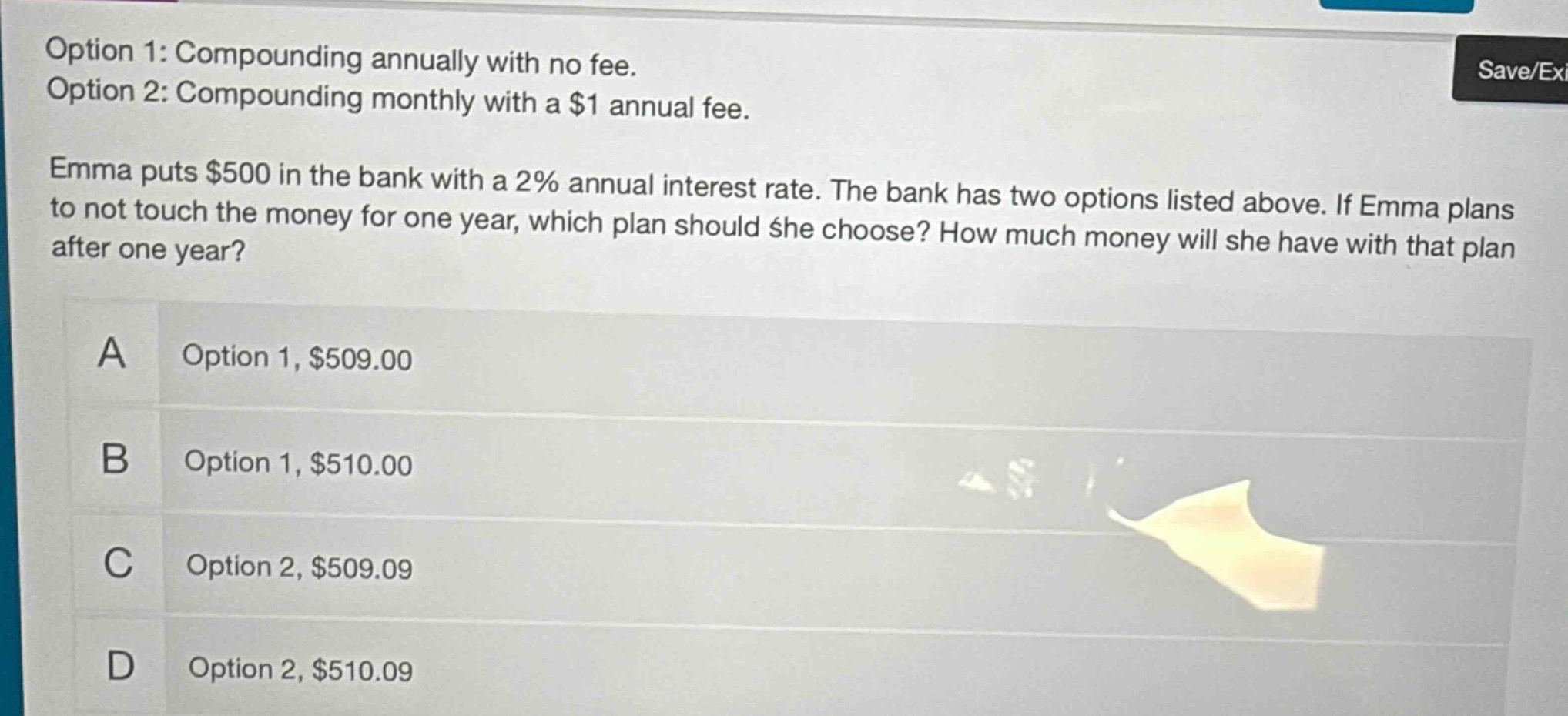
option 1: compounding annually with no fee. option 2: compounding monthly with a $1 annual fee. emma puts $500 in the bank with a 2% annual interest rate. the bank has two options listed above. if emma plans to not touch the money for one year, which plan should she choose? how much money will she have with that plan after one year? a option 1, $509.00 b option 1, $510.00 c option 2, $509.09 d option 2, $510.09
Answer
Explanation:
Step1: Calculate amount for Option 1
Use compound - interest formula $A = P(1 + r)^t$, where $P=$500$, $r = 0.02$, $t = 1$. So $A_1=500\times(1 + 0.02)^1=500\times1.02=$510$.
Step2: Calculate amount for Option 2
Use compound - interest formula $A = P(1+\frac{r}{n})^{nt}$, where $P = 500$, $r=0.02$, $n = 12$, $t = 1$. So $A = 500\times(1+\frac{0.02}{12})^{12\times1}\approx500\times(1 + 0.00167)^{12}\approx500\times1.02018=$510.09$. Then subtract the $$1$ fee, $A_2=510.09 - 1=$509.09$.
Step3: Compare the two amounts
Since $510>509.09$, Option 1 is better.
Answer:
B. Option 1, $510.00$