padraig receives total employment compensation of $70,000 and had $2,000 in job expenses. which of the…
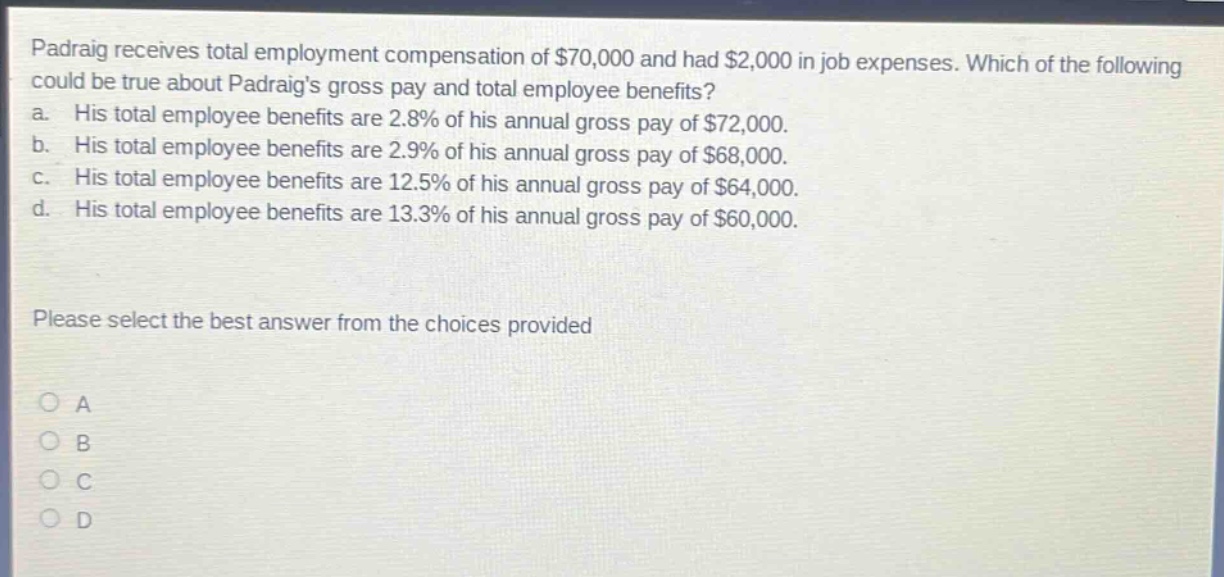
padraig receives total employment compensation of $70,000 and had $2,000 in job expenses. which of the following could be true about padraigs gross pay and total employee benefits? a. his total employee benefits are 2.8% of his annual gross pay of $72,000. b. his total employee benefits are 2.9% of his annual gross pay of $68,000. c. his total employee benefits are 12.5% of his annual gross pay of $64,000. d. his total employee benefits are 13.3% of his annual gross pay of $60,000. please select the best answer from the choices provided a b c d
Answer
Explanation:
Step1: Calculate total employment compensation after expenses
Total employment compensation after expenses = Total employment compensation - Job expenses. So, $70000 - 2000=68000$. This means the sum of gross - pay and employee benefits is $68000$.
Step2: Check option A
Let the gross pay be $72000$. Employee benefits as a percentage of gross pay is 2.8%. Employee benefits amount = $0.028\times72000 = 2016$. Gross pay+Employee benefits=$72000 + 2016=74016\neq68000$.
Step3: Check option B
Let the gross pay be $68000$. Employee benefits as a percentage of gross pay is 2.9%. Employee benefits amount = $0.029\times68000=1972$. Gross pay + Employee benefits=$68000+1972 = 69972\neq68000$.
Step4: Check option C
Let the gross pay be $64000$. Employee benefits as a percentage of gross pay is 12.5%. Employee benefits amount = $0.125\times64000 = 8000$. Gross pay+Employee benefits=$64000 + 8000=72000\neq68000$.
Step5: Check option D
Let the gross pay be $60000$. Employee benefits as a percentage of gross pay is 13.3%. Employee benefits amount = $0.133\times60000=7980$. Gross pay+Employee benefits=$60000 + 7980=67980\approx68000$.
Answer:
D. His total employee benefits are 13.3% of his annual gross pay of $60,000.