patrick spent last summer working in construction with his dad, and he put $894 of his earnings into a new…
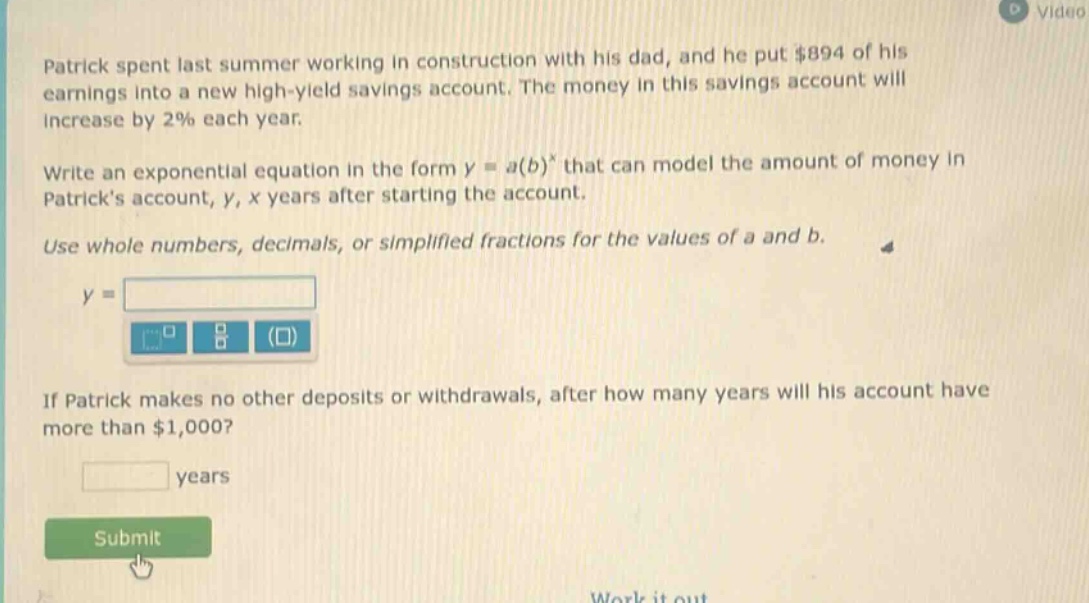
patrick spent last summer working in construction with his dad, and he put $894 of his earnings into a new high - yield savings account. the money in this savings account will increase by 2% each year. write an exponential equation in the form y = a(b)^x that can model the amount of money in patricks account, y, x years after starting the account. use whole numbers, decimals, or simplified fractions for the values of a and b. if patrick makes no other deposits or withdrawals, after how many years will his account have more than $1,000?
Answer
Explanation:
Step1: Identify the initial - value and growth factor
The initial amount of money $a$ that Patrick deposits is $a = 894$. The money increases by $2%$ each year. The growth factor $b$ is $1 + 0.02=1.02$. So the exponential equation is $y = 894(1.02)^x$.
Step2: Set up the inequality
We want to find $x$ when $y>1000$. So we set up the inequality $894(1.02)^x>1000$. First, divide both sides of the inequality by 894: $(1.02)^x>\frac{1000}{894}\approx1.1186$.
Step3: Take the natural - logarithm of both sides
Taking the natural - logarithm of both sides of the inequality $(1.02)^x>1.1186$, we get $x\ln(1.02)>\ln(1.1186)$.
Step4: Solve for $x$
Since $\ln(1.02)\approx0.0198$ and $\ln(1.1186)\approx0.112$, then $x>\frac{\ln(1.1186)}{\ln(1.02)}=\frac{0.112}{0.0198}\approx5.66$. Since $x$ represents the number of years and it must be a whole number, we round up to the next whole number.
Answer:
$y = 894(1.02)^x$ 6