a person invests 5000 dollars in a bank. the bank pays 6.25% interest compounded quarterly. to the nearest…
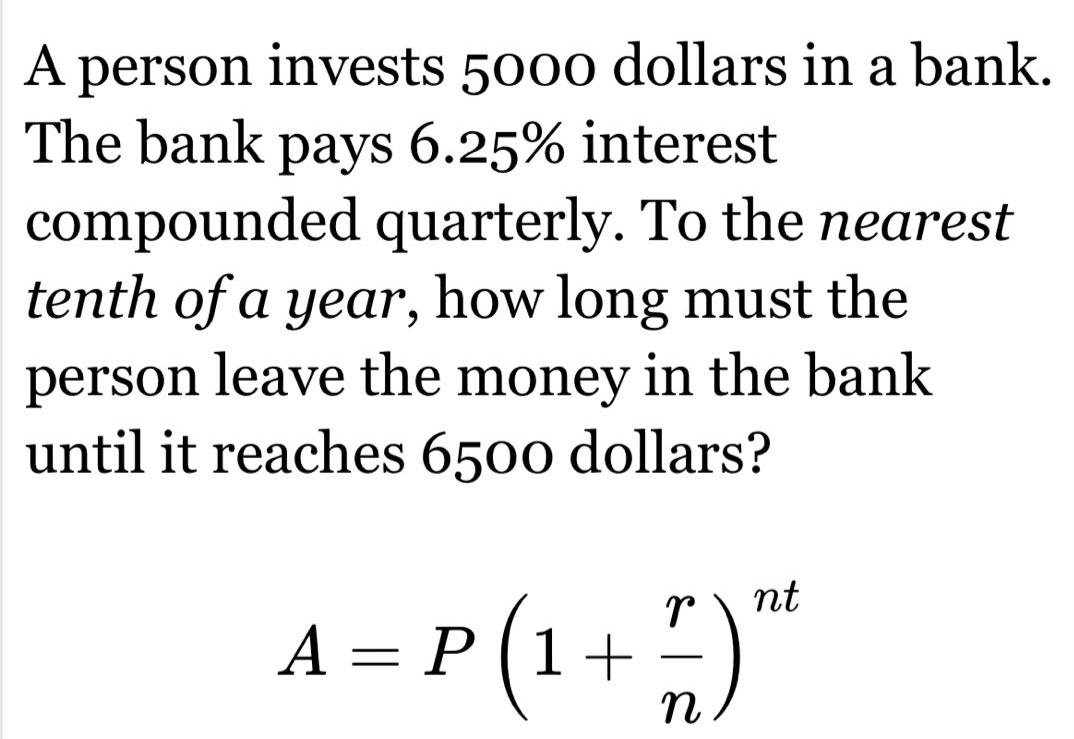
a person invests 5000 dollars in a bank. the bank pays 6.25% interest compounded quarterly. to the nearest tenth of a year, how long must the person leave the money in the bank until it reaches 6500 dollars? a = p (1 + r/n)^nt
Answer
Explanation:
Step1: Identify the values of variables
$A = 6500$, $P=5000$, $r = 0.0625$ (since $6.25%=0.0625$), $n = 4$ (compounded quarterly).
Step2: Substitute values into the compound - interest formula
$6500=5000\left(1+\frac{0.0625}{4}\right)^{4t}$.
Step3: Simplify the equation
First, divide both sides by 5000: $\frac{6500}{5000}=\left(1 + 0.015625\right)^{4t}$, so $1.3=(1.015625)^{4t}$.
Step4: Take the natural logarithm of both sides
$\ln(1.3)=\ln\left((1.015625)^{4t}\right)$. Using the property $\ln(a^b)=b\ln(a)$, we get $\ln(1.3)=4t\ln(1.015625)$.
Step5: Solve for $t$
$t=\frac{\ln(1.3)}{4\ln(1.015625)}$. Calculate $\ln(1.3)\approx0.26236$, $\ln(1.015625)\approx0.0155$, then $4\ln(1.015625)\approx0.062$. So $t=\frac{0.26236}{0.062}\approx4.2$.
Answer:
$4.2$ years