a person invests 8000 dollars in a bank. the bank pays 7% interest compounded annually. to the nearest tenth…
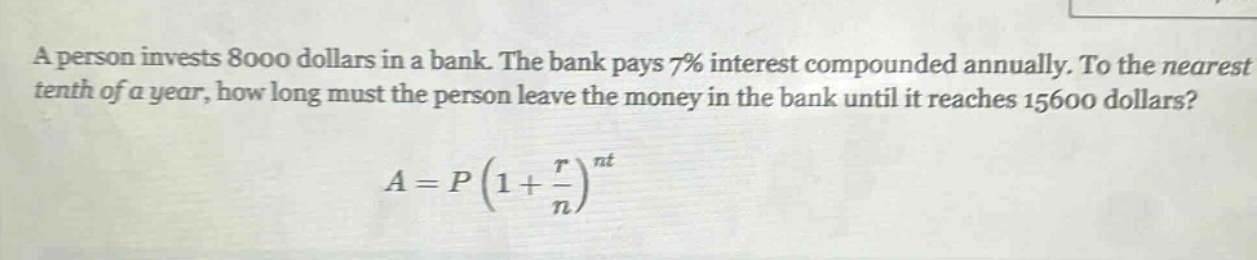
a person invests 8000 dollars in a bank. the bank pays 7% interest compounded annually. to the nearest tenth of a year, how long must the person leave the money in the bank until it reaches 15600 dollars?\n\n$a = p(1+\frac{r}{n})^{nt}$
Answer
Explanation:
Step1: Identify the values
$A = 15600$, $P=8000$, $r = 0.07$, $n = 1$ (compounded annually). Substitute into the compound - interest formula $A = P(1+\frac{r}{n})^{nt}$. $15600=8000(1 +\frac{0.07}{1})^{1\times t}$
Step2: Simplify the equation
First, divide both sides of the equation by 8000: $\frac{15600}{8000}=(1.07)^{t}$ $1.95=(1.07)^{t}$
Step3: Take the natural logarithm of both sides
$\ln(1.95)=\ln(1.07^{t})$ Using the property of logarithms $\ln(a^{b})=b\ln(a)$, we get: $\ln(1.95)=t\ln(1.07)$
Step4: Solve for t
$t=\frac{\ln(1.95)}{\ln(1.07)}$ $\ln(1.95)\approx0.667$ and $\ln(1.07)\approx0.068$ $t=\frac{0.667}{0.068}\approx9.8$
Answer:
$9.8$