porsha calculates the amount of money she will have at the end of 6 years on a $5,000 investment earning…
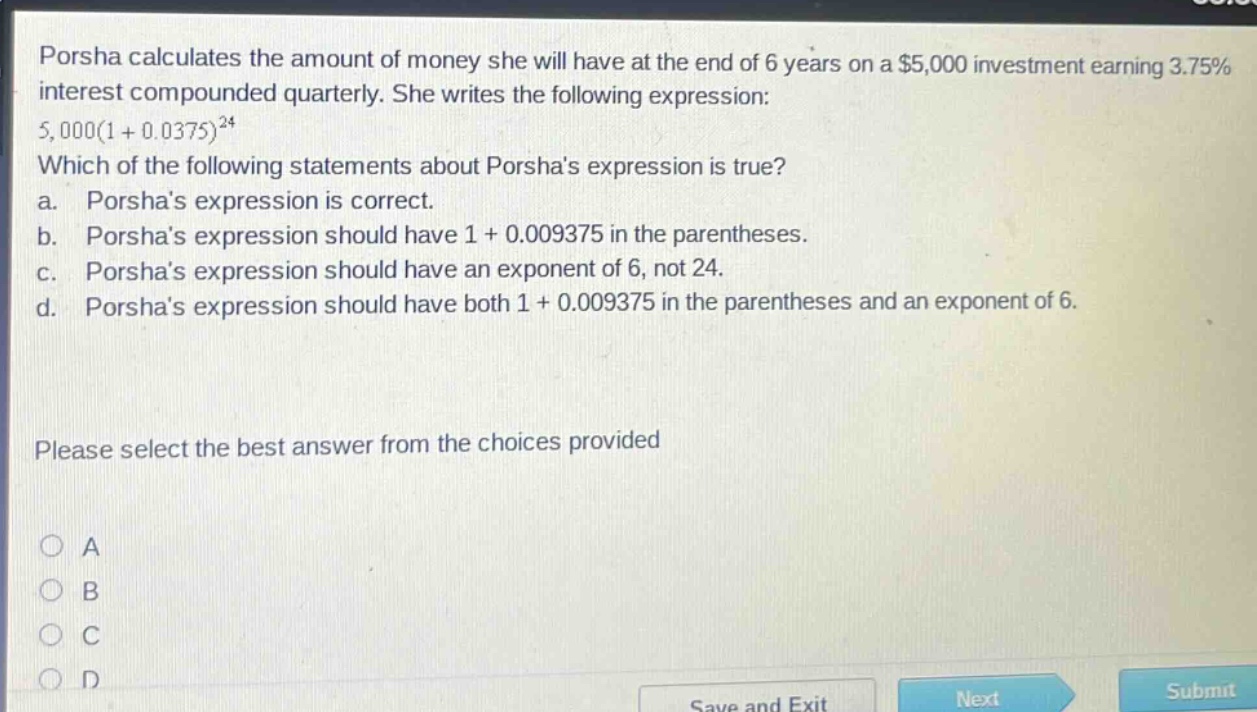
porsha calculates the amount of money she will have at the end of 6 years on a $5,000 investment earning 3.75% interest compounded quarterly. she writes the following expression: 5,000(1 + 0.0375)^24 which of the following statements about porshas expression is true? a. porshas expression is correct. b. porshas expression should have 1 + 0.009375 in the parentheses. c. porshas expression should have an exponent of 6, not 24. d. porshas expression should have both 1 + 0.009375 in the parentheses and an exponent of 6. please select the best answer from the choices provided
Answer
Explanation:
Step1: Recall compound - interest formula
The compound - interest formula is $A = P(1+\frac{r}{n})^{nt}$, where $P$ is the principal amount, $r$ is the annual interest rate (in decimal), $n$ is the number of times interest is compounded per year, and $t$ is the number of years.
Step2: Identify the values given
Here, $P = 5000$, $r=0.0375$, $n = 4$ (compounded quarterly), and $t = 6$.
Step3: Calculate the interest rate per period and the number of periods
The interest rate per period is $\frac{r}{n}=\frac{0.0375}{4}=0.009375$. The number of periods is $nt=4\times6 = 24$.
Step4: Write the correct expression
The correct expression for the amount $A$ is $A = 5000(1 + 0.009375)^{24}$. So Porsha's expression should have $1+0.009375$ in the parentheses.
Answer:
B. Porsha's expression should have 1 + 0.009375 in the parentheses.