a principal of $2500 is invested at 3.25% interest, compounded annually. how many years will it take to…
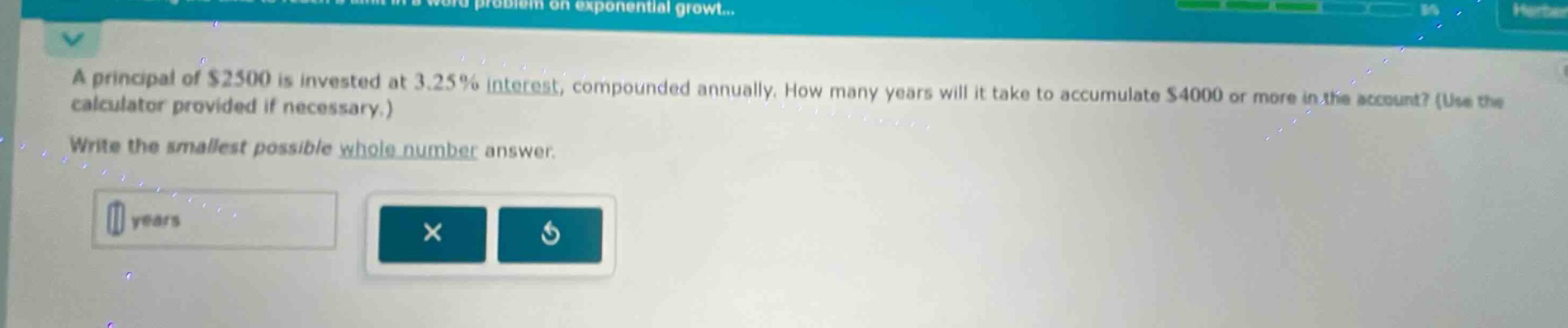
a principal of $2500 is invested at 3.25% interest, compounded annually. how many years will it take to accumulate $4000 or more in the account? (use the calculator provided if necessary.) write the smallest possible whole - number answer.
Answer
Explanation:
Step1: Write compound - interest formula
The compound - interest formula is $A = P(1 + r)^t$, where $A$ is the final amount, $P$ is the principal amount, $r$ is the annual interest rate (in decimal form), and $t$ is the number of years. Given $P=$2500$, $r = 0.0325$, and we want $A\geq4000$. So the inequality is $4000\leq2500(1 + 0.0325)^t$.
Step2: Simplify the inequality
Divide both sides of the inequality by 2500: $\frac{4000}{2500}\leq(1.0325)^t$, which simplifies to $1.6\leq(1.0325)^t$.
Step3: Take the natural logarithm of both sides
$\ln(1.6)\leq\ln(1.0325^t)$. Using the property of logarithms $\ln(a^b)=b\ln(a)$, we get $\ln(1.6)\leq t\ln(1.0325)$.
Step4: Solve for $t$
$t\geq\frac{\ln(1.6)}{\ln(1.0325)}$. Calculate $\frac{\ln(1.6)}{\ln(1.0325)}=\frac{0.4700036292}{0.0320049567}\approx14.68$.
Answer:
15