9. a principal amount of $4200, earns 3.6% interest compounded quarterly. how long does it take for the…
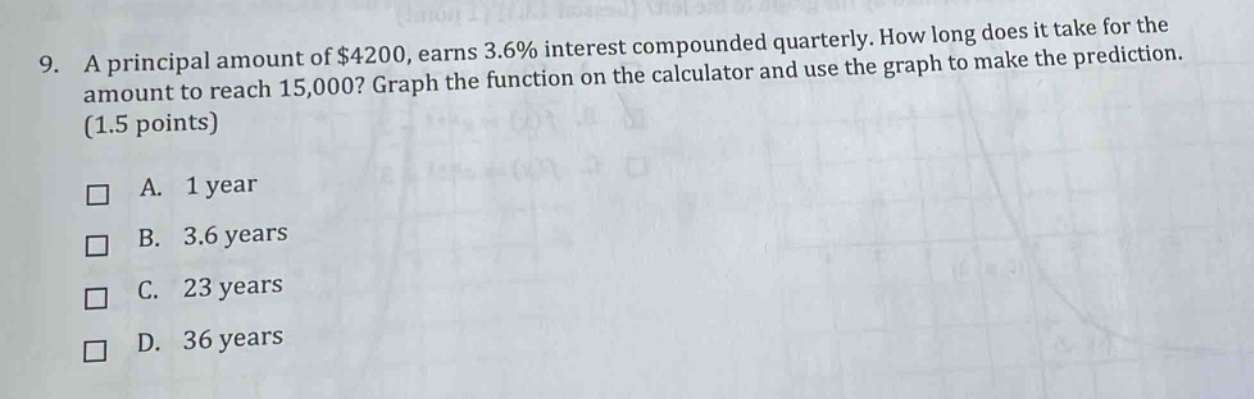
9. a principal amount of $4200, earns 3.6% interest compounded quarterly. how long does it take for the amount to reach 15,000? graph the function on the calculator and use the graph to make the prediction. (1.5 points) a. 1 year b. 3.6 years c. 23 years d. 36 years
Answer
Explanation:
Step1: Recall compound - interest formula
The compound - interest formula is $A = P(1+\frac{r}{n})^{nt}$, where $A$ is the final amount, $P$ is the principal amount, $r$ is the annual interest rate (in decimal form), $n$ is the number of times interest is compounded per year, and $t$ is the number of years. Given $P = 4200$, $r=0.036$, $n = 4$ (compounded quarterly), and $A = 15000$. Substitute these values into the formula: $15000=4200(1 +\frac{0.036}{4})^{4t}$
Step2: Simplify the equation
First, simplify $1+\frac{0.036}{4}=1 + 0.009=1.009$. The equation becomes $\frac{15000}{4200}=(1.009)^{4t}$. $\frac{25}{7}=(1.009)^{4t}$. Take the natural logarithm of both sides: $\ln(\frac{25}{7})=\ln((1.009)^{4t})$. Using the property of logarithms $\ln(a^b)=b\ln(a)$, we get $\ln(\frac{25}{7}) = 4t\ln(1.009)$.
Step3: Solve for $t$
We know that $\ln(\frac{25}{7})\approx\ln(25)-\ln(7)\approx3.218876 - 1.94591 = 1.272966$ and $\ln(1.009)\approx0.00896$. Then $1.272966 = 4t\times0.00896$. $4t=\frac{1.272966}{0.00896}\approx142.184$. $t=\frac{142.184}{4}\approx35.546\approx36$ years.
Answer:
D. 36 years