question 10 of 25\na savings account at bank a pays 5% simple interest. an account at bank b pays 2%…
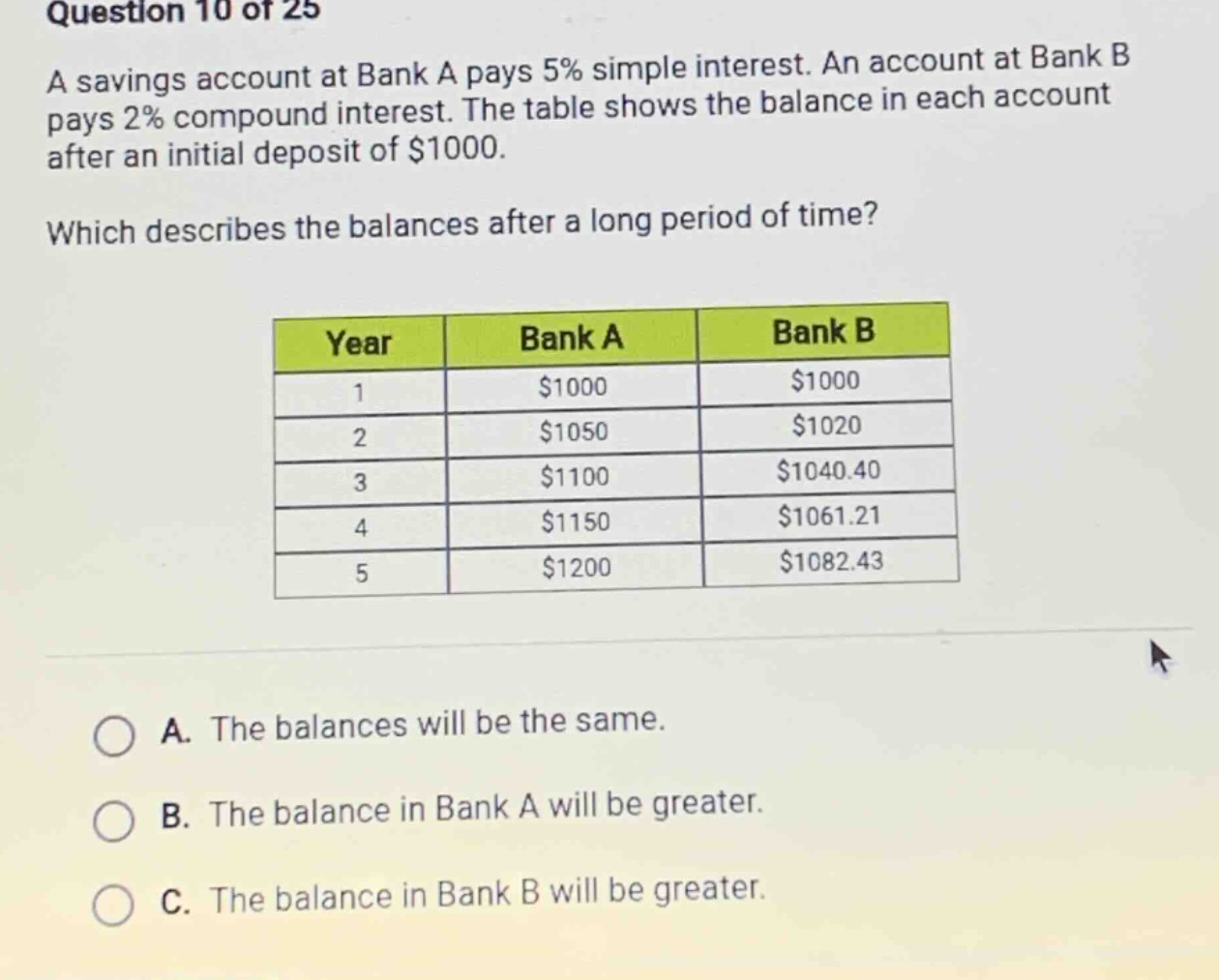
question 10 of 25\na savings account at bank a pays 5% simple interest. an account at bank b pays 2% compound interest. the table shows the balance in each account after an initial deposit of $1000.\nwhich describes the balances after a long period of time?\n| year | bank a | bank b |\n| ---- | ---- | ---- |\n| 1 | $1000 | $1000 |\n| 2 | $1050 | $1020 |\n| 3 | $1100 | $1040.40 |\n| 4 | $1150 | $1061.21 |\n| 5 | $1200 | $1082.43 |\na. the balances will be the same.\nb. the balance in bank a will be greater.\nc. the balance in bank b will be greater.
Answer
Explanation:
Step1: Recall simple - interest formula
The simple - interest formula is $A = P(1+rt)$, where $P=$1000$, $r = 0.05$, and $t$ is the number of years. So $A_A=1000(1 + 0.05t)=1000+50t$.
Step2: Recall compound - interest formula
The compound - interest formula is $A = P(1 + r)^t$, where $P = 1000$, $r=0.02$. So $A_B = 1000(1 + 0.02)^t=1000\times1.02^t$.
Step3: Analyze for large $t$
As $t$ gets very large, the function $y = 1000+50t$ (linear function) and $y = 1000\times1.02^t$ (exponential function). The exponential function $y = a\times b^t$ ($a = 1000$, $b=1.02>1$) will grow faster than the linear function $y=mx + c$ ($m = 50$, $c = 1000$) for large values of $t$.
Answer:
C. The balance in Bank B will be greater.