question\n9,600 dollars is placed in a savings account with an annual interest rate of 1.2%. if no money is…
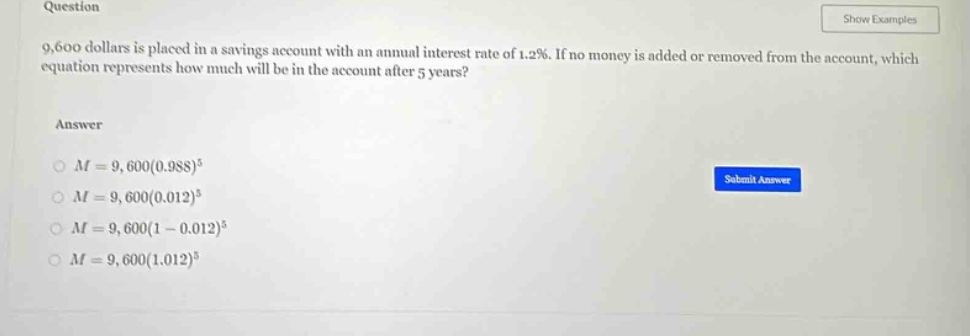
question\n9,600 dollars is placed in a savings account with an annual interest rate of 1.2%. if no money is added or removed from the account, which equation represents how much will be in the account after 5 years?\nanswer\n$m = 9,600(0.988)^{5}$\n$m = 9,600(0.012)^{5}$\n$m = 9,600(1 - 0.012)^{5}$\n$m = 9,600(1.012)^{5}$
Answer
Explanation:
Step1: Identify the compound - interest formula
The compound - interest formula is $A = P(1 + r)^t$, where $P$ is the principal amount, $r$ is the annual interest rate (in decimal form), and $t$ is the number of years.
Step2: Convert the interest rate to decimal
The annual interest rate is $1.2%$. To convert it to decimal, we divide by 100: $r=\frac{1.2}{100}=0.012$.
Step3: Identify the principal and number of years
The principal amount $P = 9600$ dollars and the number of years $t = 5$.
Step4: Substitute values into the formula
Substituting $P = 9600$, $r=0.012$, and $t = 5$ into the formula $A = P(1 + r)^t$, we get $A=9600(1 + 0.012)^5=9600(1.012)^5$.
Answer:
$M = 9,600(1.012)^5$