question carson invested $2,700 in an account paying an interest rate of 1.6% compounded continuously…
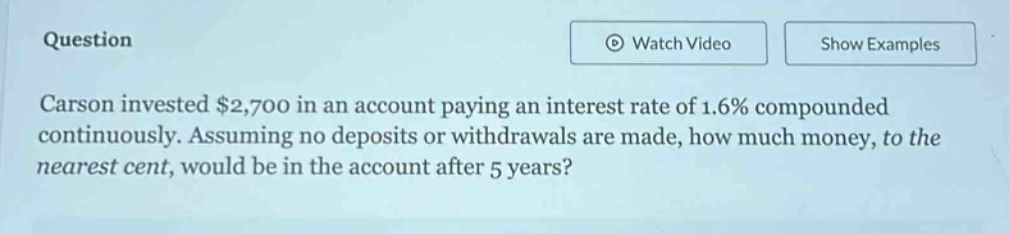
question carson invested $2,700 in an account paying an interest rate of 1.6% compounded continuously. assuming no deposits or withdrawals are made, how much money, to the nearest cent, would be in the account after 5 years?
Answer
Explanation:
Step1: Recall continuous - compounding formula
The formula for continuous - compounding is $A = Pe^{rt}$, where $A$ is the amount of money in the account after $t$ years, $P$ is the principal amount (initial investment), $r$ is the annual interest rate (in decimal form), and $t$ is the number of years.
Step2: Convert the interest rate to decimal
The interest rate $r = 1.6%=0.016$, $P = 2700$, and $t = 5$.
Step3: Substitute values into the formula
$A=2700\times e^{0.016\times5}$. First, calculate the exponent: $0.016\times5 = 0.08$. Then, find the value of $e^{0.08}$. Using a calculator, $e^{0.08}\approx1.083287$. Now, multiply by the principal: $A = 2700\times1.083287=2924.8749$.
Step4: Round to the nearest cent
Rounding $2924.8749$ to the nearest cent gives $2924.87$.
Answer:
$2924.87$