question 6 (essay worth 4 points) (an interest in growth models hc) a principal amount of $7,000 is placed…
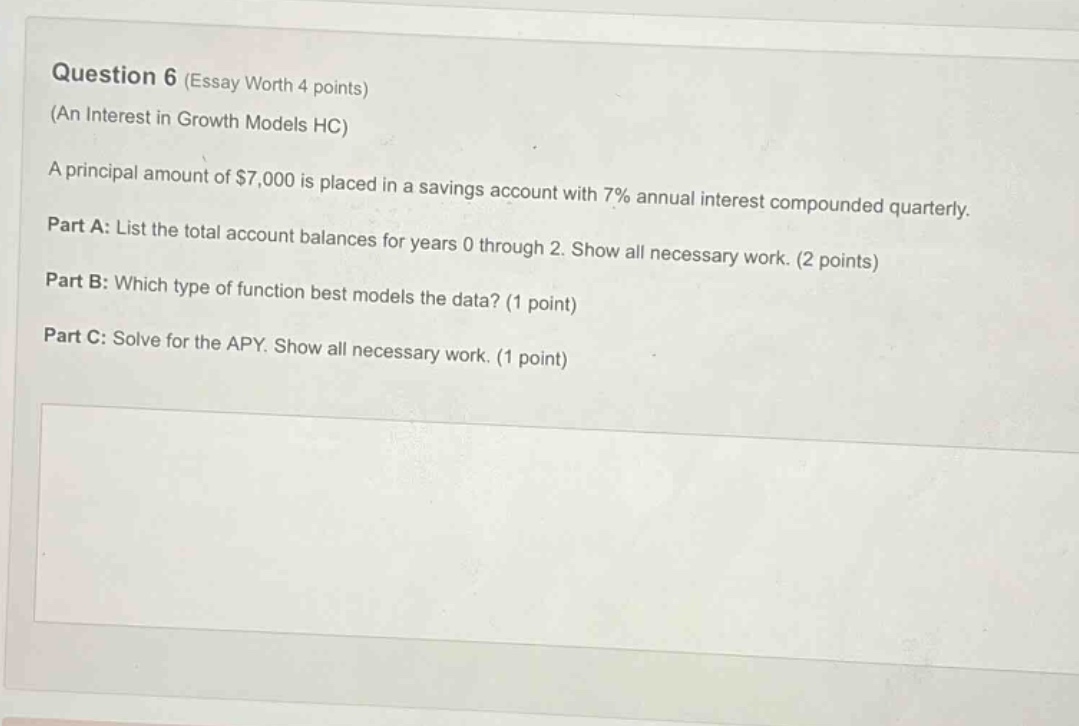
question 6 (essay worth 4 points) (an interest in growth models hc) a principal amount of $7,000 is placed in a savings account with 7% annual interest compounded quarterly. part a: list the total account balances for years 0 through 2. show all necessary work. (2 points) part b: which type of function best models the data? (1 point) part c: solve for the apy. show all necessary work. (1 point)
Answer
Explanation:
Step1: Recall compound - interest formula
The compound - interest formula is $A = P(1+\frac{r}{n})^{nt}$, where $P$ is the principal amount, $r$ is the annual interest rate (in decimal form), $n$ is the number of times interest is compounded per year, and $t$ is the number of years. Here, $P=$7000$, $r = 0.07$, and $n = 4$.
Step2: Calculate account balances for years 0 - 2 (Part A)
Year 0:
When $t = 0$, $A_0=P(1+\frac{r}{n})^{n\times0}=7000(1 +\frac{0.07}{4})^{0}=7000$.
Year 0.25:
When $t = 0.25$, $A_{0.25}=7000(1+\frac{0.07}{4})^{4\times0.25}=7000(1 + 0.0175)=7000\times1.0175 = 7122.5$.
Year 0.5:
When $t = 0.5$, $A_{0.5}=7000(1+\frac{0.07}{4})^{4\times0.5}=7000(1.0175)^{2}=7000\times1.03525625 = 7246.79375$.
Year 0.75:
When $t = 0.75$, $A_{0.75}=7000(1+\frac{0.07}{4})^{4\times0.75}=7000(1.0175)^{3}=7000\times1.053295515625\approx7373.07$.
Year 1:
When $t = 1$, $A_1=7000(1+\frac{0.07}{4})^{4\times1}=7000(1.0175)^{4}=7000\times1.07185903125\approx7502.91$.
Year 1.25:
When $t = 1.25$, $A_{1.25}=7000(1+\frac{0.07}{4})^{4\times1.25}=7000(1.0175)^{5}=7000\times1.090309415391\approx7632.16$.
Year 1.5:
When $t = 1.5$, $A_{1.5}=7000(1+\frac{0.07}{4})^{4\times1.5}=7000(1.0175)^{6}=7000\times1.10892379967\approx7762.47$.
Year 1.75:
When $t = 1.75$, $A_{1.75}=7000(1+\frac{0.07}{4})^{4\times1.75}=7000(1.0175)^{7}=7000\times1.12770214452\approx7893.91$.
Year 2:
When $t = 2$, $A_2=7000(1+\frac{0.07}{4})^{4\times2}=7000(1.0175)^{8}=7000\times1.14665290205\approx8026.57$.
Step3: Determine the function type (Part B)
The data is best modeled by an exponential function of the form $y = a(b)^x$, where $a$ is the initial amount ($a = 7000$) and $b=(1+\frac{0.07}{4})$ and $x = 4t$.
Step4: Calculate the APY (Part C)
The APY formula is $APY=(1+\frac{r}{n})^{n}-1$. Substituting $r = 0.07$ and $n = 4$, we get $APY=(1+\frac{0.07}{4})^{4}-1=(1.0175)^{4}-1=1.07185903125 - 1=0.07185903125\approx7.19%$.
Answer:
Part A: Year 0: $$7000$ Year 0.25: $$7122.5$ Year 0.5: $$7246.79$ Year 0.75: $$7373.07$ Year 1: $$7502.91$ Year 1.25: $$7632.16$ Year 1.5: $$7762.47$ Year 1.75: $$7893.91$ Year 2: $$8026.57$ Part B: Exponential function Part C: $7.19%$