question 2\nthis question has two parts. first, answer part a. then, answer part b.\npart a\nfinance corey…
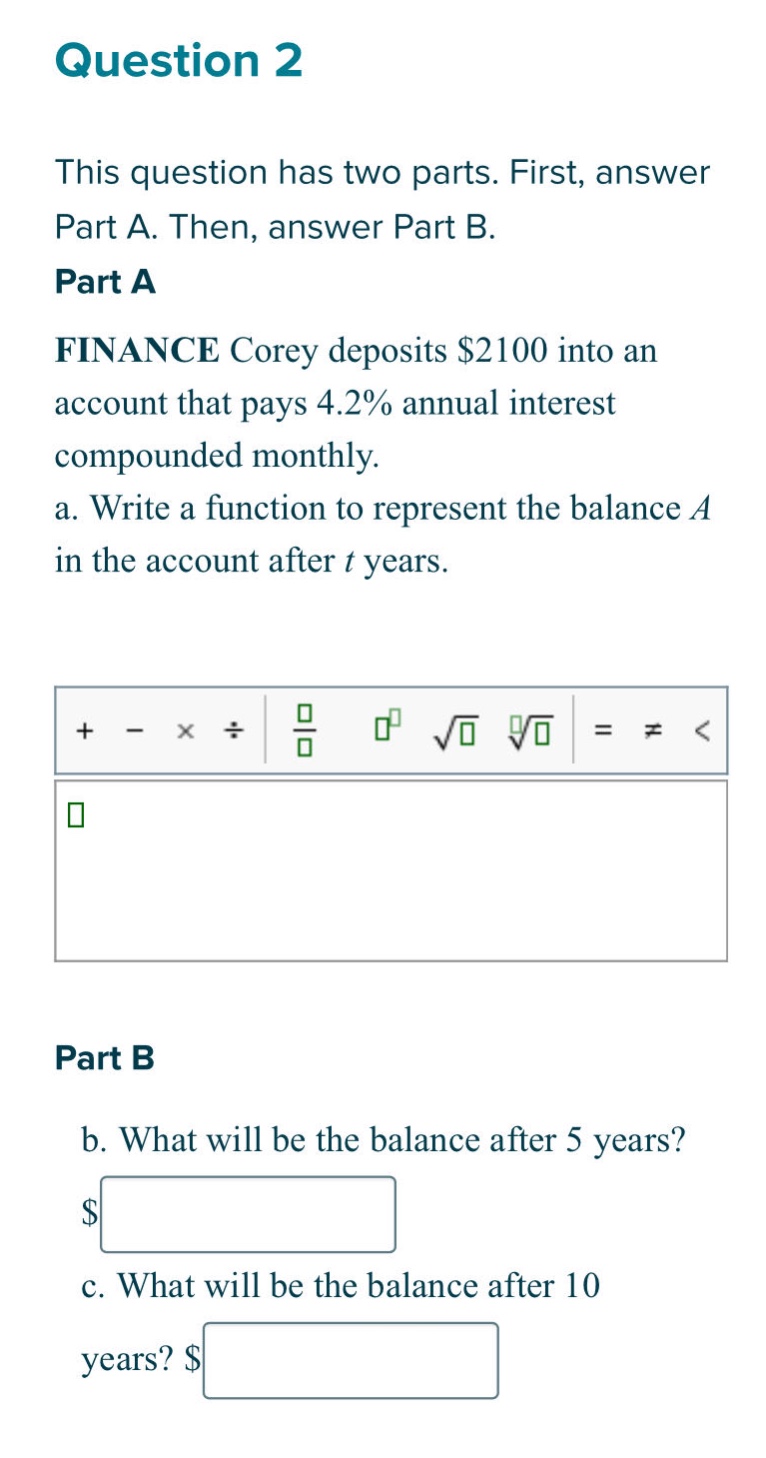
question 2\nthis question has two parts. first, answer part a. then, answer part b.\npart a\nfinance corey deposits $2100 into an account that pays 4.2% annual interest compounded monthly.\na. write a function to represent the balance a in the account after t years.\npart b\nb. what will be the balance after 5 years?\nc. what will be the balance after 10 years?
Answer
Explanation:
Step1: Recall compound - interest formula
The compound - interest formula is $A = P(1+\frac{r}{n})^{nt}$, where $P$ is the principal amount, $r$ is the annual interest rate (in decimal form), $n$ is the number of times interest is compounded per year, and $t$ is the number of years. Given $P = 2100$, $r=0.042$ (since $4.2%=0.042$), and $n = 12$ (compounded monthly). The function for the balance $A$ in the account after $t$ years is $A(t)=2100(1 +\frac{0.042}{12})^{12t}=2100(1 + 0.0035)^{12t}=2100(1.0035)^{12t}$.
Step2: Calculate balance after 5 years
Substitute $t = 5$ into the function $A(t)$. $A(5)=2100(1.0035)^{12\times5}=2100(1.0035)^{60}$. $(1.0035)^{60}\approx1.232997$. $A(5)=2100\times1.232997\approx2589.29$.
Step3: Calculate balance after 10 years
Substitute $t = 10$ into the function $A(t)$. $A(10)=2100(1.0035)^{12\times10}=2100(1.0035)^{120}$. $(1.0035)^{120}\approx1.521997$. $A(10)=2100\times1.521997\approx3196.19$.
Answer:
Part A: $A(t)=2100(1.0035)^{12t}$ Part B: b. $$2589.29$ c. $$3196.19$