question\nsamuel deposits $100 in a high - interest account that has an interest rate of 10% compounded…
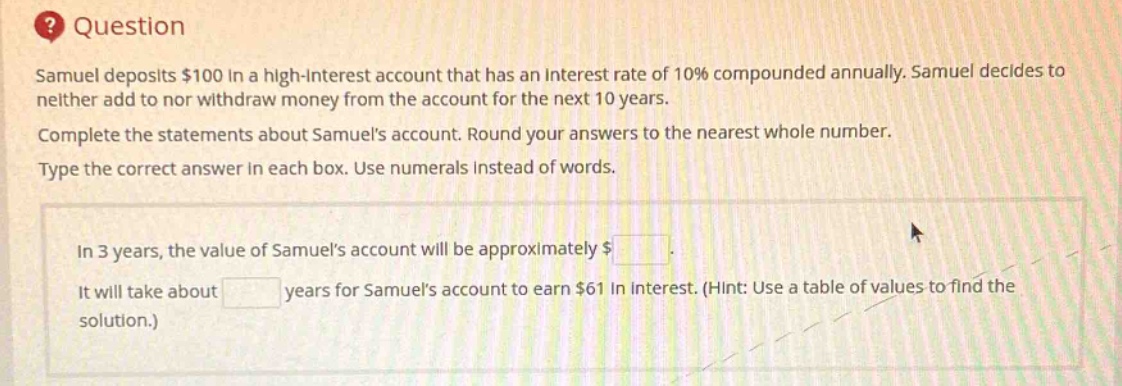
question\nsamuel deposits $100 in a high - interest account that has an interest rate of 10% compounded annually. samuel decides to neither add to nor withdraw money from the account for the next 10 years.\ncomplete the statements about samuels account. round your answers to the nearest whole number.\ntype the correct answer in each box. use numerals instead of words.\nin 3 years, the value of samuels account will be approximately $ \nit will take about years for samuels account to earn $61 in interest. (hint: use a table of values to find the solution.)
Answer
Explanation:
Step1: Recall compound - interest formula
The compound - interest formula is $A = P(1 + r)^t$, where $P$ is the principal amount, $r$ is the annual interest rate (as a decimal), and $t$ is the number of years. Here, $P=$100$, $r = 0.1$, and for the first part $t = 3$.
Step2: Calculate the value of the account in 3 years
Substitute the values into the formula: $A=100(1 + 0.1)^3=100\times(1.1)^3=100\times1.331 = 133.1\approx133$.
Step3: Set up an equation for the second part
We want to find $t$ when the interest $I=A - P = 61$. Since $A = P(1 + r)^t$ and $P = 100$, $r=0.1$, we have $100(1 + 0.1)^t-100=61$. Then $100(1.1)^t=161$, and $(1.1)^t=\frac{161}{100}=1.61$.
Step4: Use a table of values or logarithms
We can check values of $t$. For $t = 5$, $(1.1)^5=1.1\times1.1\times1.1\times1.1\times1.1 = 1.61051\approx1.61$.
Answer:
In 3 years, the value of Samuel's account will be approximately $$133$. It will take about $5$ years for Samuel's account to earn $$61$ in interest.