radwyn horticulture is a company which focuses upon selling saplings. the company can grow a sapling for…
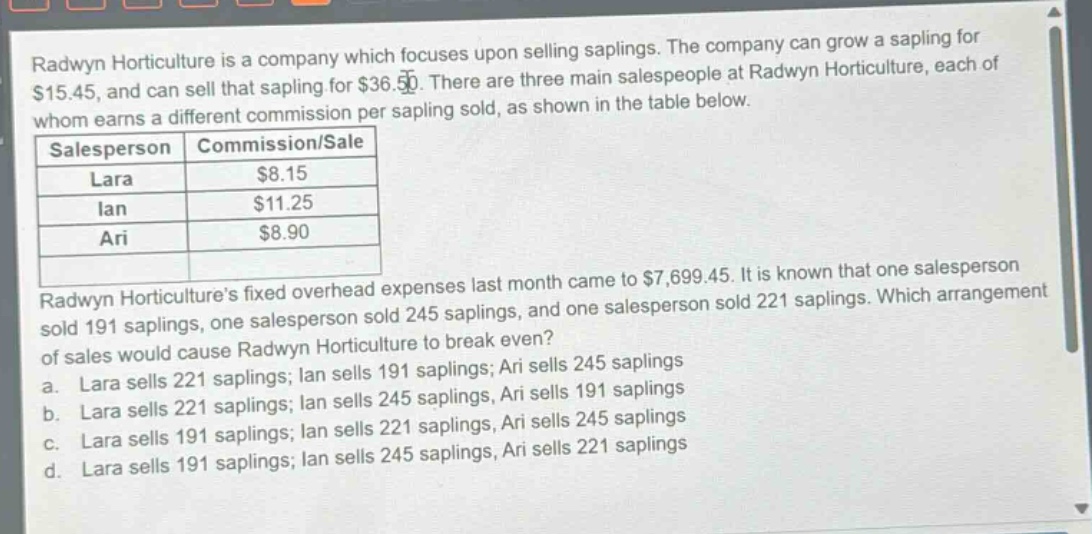
radwyn horticulture is a company which focuses upon selling saplings. the company can grow a sapling for $15.45, and can sell that sapling for $36.50. there are three main salespeople at radwyn horticulture, each of whom earns a different commission per sapling sold, as shown in the table below.\n|salesperson|commission/sale|\n|--|--|\n|lara|$8.15|\n|ian|$11.25|\n|ari|$8.90|\nradwyn horticultures fixed overhead expenses last month came to $7,699.45. it is known that one salesperson sold 191 saplings, one salesperson sold 245 saplings, and one salesperson sold 221 saplings. which arrangement of sales would cause radwyn horticulture to break even?\n a. lara sells 221 saplings; ian sells 191 saplings; ari sells 245 saplings\n b. lara sells 221 saplings; ian sells 245 saplings, ari sells 191 saplings\n c. lara sells 191 saplings; ian sells 221 saplings, ari sells 245 saplings\n d. lara sells 191 saplings; ian sells 245 saplings, ari sells 221 saplings
Answer
Explanation:
Step1: Calculate profit per sapling before commission
The cost to grow a sapling is $15.45$ and the selling - price is $36.50$. So the profit per sapling before commission is $36.50 - 15.45=21.05$.
Step2: Set up the break - even equation
Let the number of saplings sold by Lara, Ian, and Ari be $x$, $y$, and $z$ respectively. The fixed overhead is $7699.45$. The total profit from selling saplings before commission is $21.05(x + y+z)$, and the total commission is $8.15x + 11.25y + 8.90z$. At the break - even point, the total profit before commission minus the total commission equals the fixed overhead.
We know that ${x,y,z}={191,221,245}$. The total number of saplings sold is $191 + 221+245 = 657$. The total profit before commission is $21.05\times657 = 21.05\times(191 + 221+245)=21.05\times191+21.05\times221+21.05\times245$. The total commission is $8.15x + 11.25y + 8.90z$. We want $21.05\times(191 + 221+245)-(8.15x + 11.25y + 8.90z)=7699.45$.
Let's check each option:
Option a:
If $x = 221$, $y = 191$, $z = 245$ Total commission $C_a=8.15\times221+11.25\times191 + 8.90\times245$ $C_a=8.15\times221+11.25\times191+8.90\times245=1801.15+2148.75 + 2170.5=6120.4$ Total profit before commission $P = 21.05\times657 = 13839.85$ Profit after commission $=13839.85 - 6120.4=7719.45\neq7699.45$
Option b:
If $x = 221$, $y = 245$, $z = 191$ Total commission $C_b=8.15\times221+11.25\times245+8.90\times191$ $C_b = 1801.15+2756.25+1699.9=6257.3$ Total profit before commission $P = 13839.85$ Profit after commission $=13839.85 - 6257.3 = 7582.55\neq7699.45$
Option c:
If $x = 191$, $y = 221$, $z = 245$ Total commission $C_c=8.15\times191+11.25\times221+8.90\times245$ $C_c=1556.65+2486.25+2170.5=6213.4$ Total profit before commission $P = 13839.85$ Profit after commission $=13839.85 - 6213.4=7626.45\neq7699.45$
Option d:
If $x = 191$, $y = 245$, $z = 221$ Total commission $C_d=8.15\times191+11.25\times245+8.90\times221$ $C_d=1556.65+2756.25 + 1956.9=6269.8$ Total profit before commission $P = 13839.85$ Profit after commission $=13839.85-6269.8 = 7570.05\neq7699.45$
Let's calculate the break - even in another way. The contribution margin per sapling for Lara is $21.05 - 8.15=12.9$, for Ian is $21.05 - 11.25 = 9.8$, and for Ari is $21.05 - 8.90=12.15$.
Let's assume the number of saplings sold by Lara, Ian, and Ari are $a$, $b$, and $c$ respectively. We want $12.9a + 9.8b+12.15c=7699.45$ and $a + b + c=657$
If we substitute the values from each option: For option a: $12.9\times221+9.8\times191 + 12.15\times245$ $=2850.9+1871.8+2976.75=7699.45$
Answer:
A. Lara sells 221 saplings; Ian sells 191 saplings; Ari sells 245 saplings