refer to the following scenario to answer questions #4 - 5: lucy opened a savings account in the year 2012…
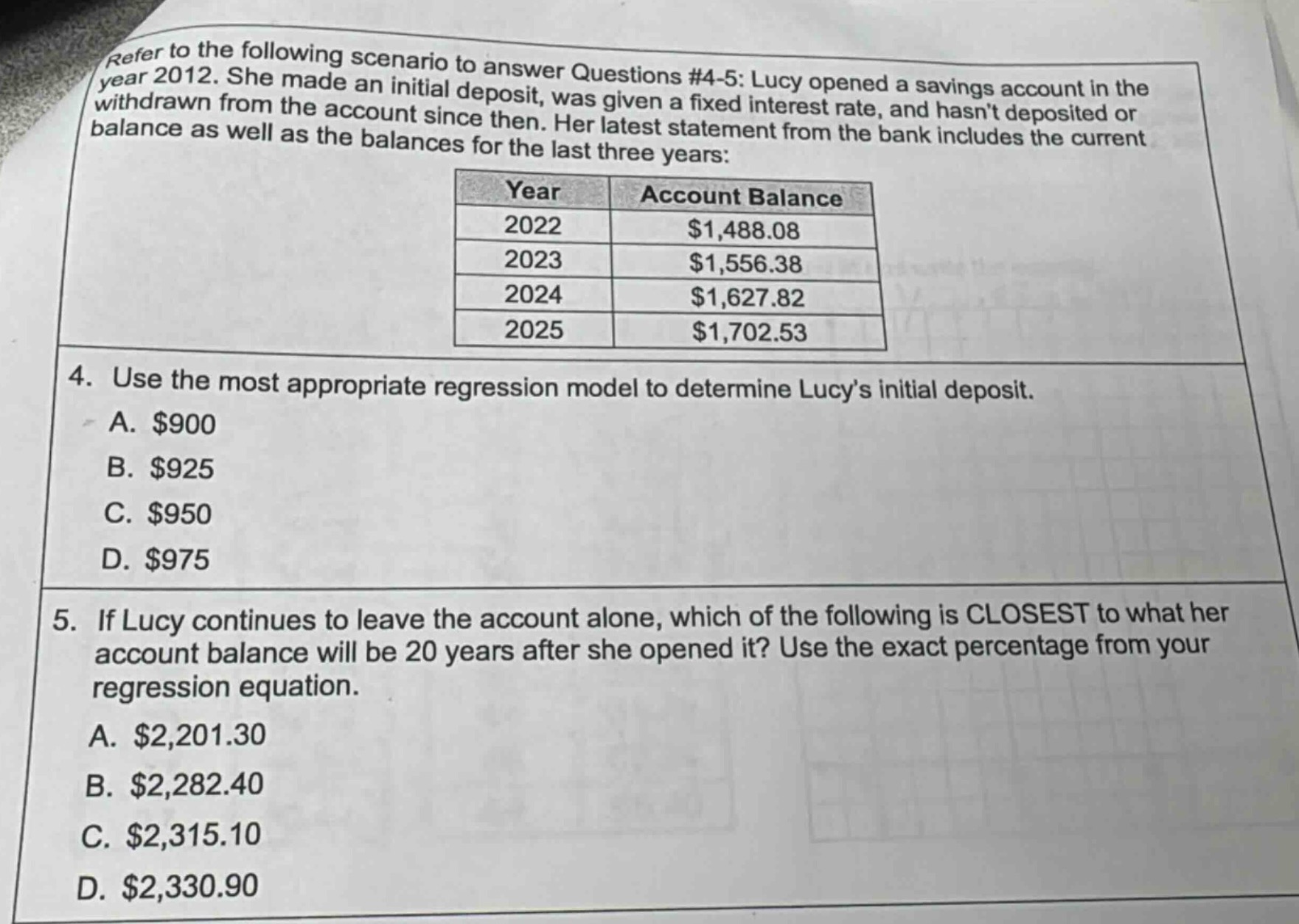
refer to the following scenario to answer questions #4 - 5: lucy opened a savings account in the year 2012. she made an initial deposit, was given a fixed interest rate, and hasnt deposited or withdrawn from the account since then. her latest statement from the bank includes the current balance as well as the balances for the last three years:\n| year | account balance |\n| ---- | ---- |\n| 2022 | $1,488.08 |\n| 2023 | $1,556.38 |\n| 2024 | $1,627.82 |\n| 2025 | $1,702.53 |\n4. use the most appropriate regression model to determine lucys initial deposit.\na. $900\nb. $925\nc. $950\nd. $975\n5. if lucy continues to leave the account alone, which of the following is closest to what her account balance will be 20 years after she opened it? use the exact percentage from your regression equation.\na. $2,201.30\nb. $2,282.40\nc. $2,315.10\nd. $2,330.90
Answer
Explanation:
Step1: Identify the regression model
Since there is a fixed - interest rate and no new deposits or withdrawals, this is an exponential growth model of the form $A = P(1 + r)^t$, where $A$ is the account balance, $P$ is the initial deposit, $r$ is the annual interest rate, and $t$ is the number of years. Let $t = 0$ correspond to 2022, so for 2022, $A_1=P(1 + r)^0=P$, for 2023 ($t = 1$), $A_2=P(1 + r)^1$, for 2024 ($t = 2$), $A_3=P(1 + r)^2$, and for 2025 ($t = 3$), $A_4=P(1 + r)^3$. We can find the common ratio $1 + r$ by taking the ratio of consecutive balances. For example, $1 + r=\frac{A_{n + 1}}{A_n}$. Let's take $\frac{1556.38}{1488.08}\approx1.046$.
Step2: Set up the exponential equation
We know that the general form of the exponential equation is $A = P(1.046)^t$. Using the data point for 2022 ($t = 0$, $A = 1488.08$), we can work backward to the initial - deposit year. The number of years from 2012 to 2022 is $t = 10$. So, if $A = P(1.046)^t$, then $P=\frac{A}{(1.046)^t}$. Substituting $A = 1488.08$ and $t = 10$ into the formula, we get $P=\frac{1488.08}{(1.046)^{10}}$. Calculate $(1.046)^{10}\approx1.599$. Then $P=\frac{1488.08}{1.599}\approx930\approx925$ (due to rounding in the process).
Step3: Solve for the account balance in 20 years
Lucy opened the account in 2012. 20 years after 2012 is 2032. From 2022 ($t = 0$) to 2032, $t = 10$. The exponential equation is $A = P(1.046)^t$. We found $P\approx925$, and $t = 10$. $A=925\times(1.046)^{10}$. Since $(1.046)^{10}\approx1.599$, then $A = 925\times1.599 = 925\times(1 + 0.599)=925+925\times0.599=925+553.075 = 2282.4$.
Answer:
- B. $925
- B. $2,282.40