a retail manager constructs a 95% confidence interval to estimate the mean amount of money each customer…
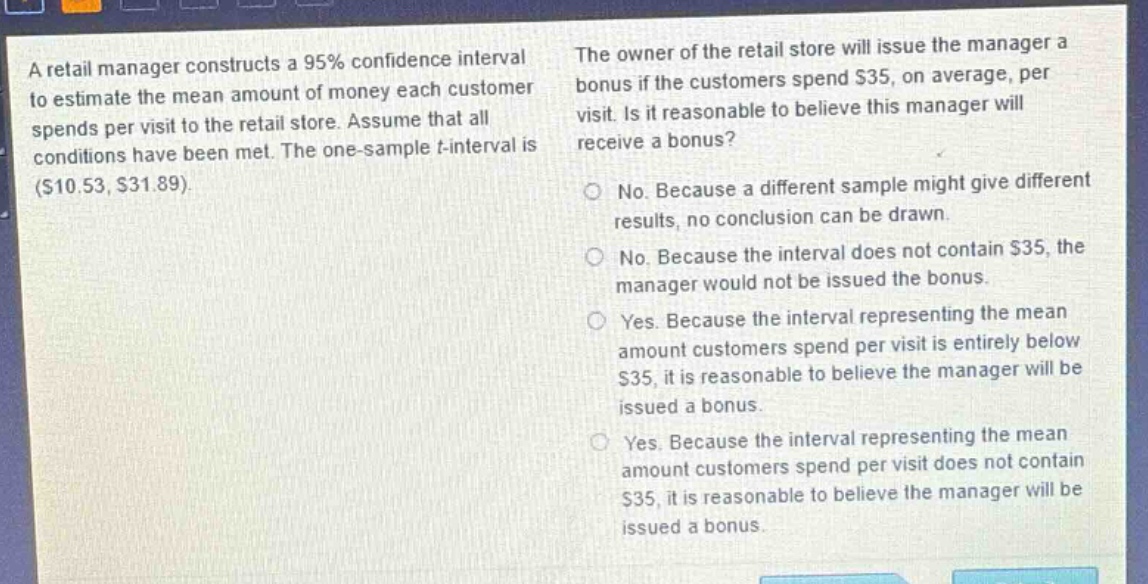
a retail manager constructs a 95% confidence interval to estimate the mean amount of money each customer spends per visit to the retail store. assume that all conditions have been met. the one - sample t - interval is ($10.53, $31.89). the owner of the retail store will issue the manager a bonus if the customers spend $35, on average, per visit. is it reasonable to believe this manager will receive a bonus? no. because a different sample might give different results, no conclusion can be drawn. no. because the interval does not contain $35, the manager would not be issued the bonus. yes. because the interval representing the mean amount customers spend per visit is entirely below $35, it is reasonable to believe the manager will be issued a bonus. yes. because the interval representing the mean amount customers spend per visit does not contain $35, it is reasonable to believe the manager will be issued a bonus.
Answer
Explanation:
Step1: Analyze the confidence - interval
The 95% confidence interval for the mean amount of money each customer spends per visit is ($10.53, $31.89). The owner will issue a bonus if the mean amount customers spend per visit is $35.
Step2: Check if $35$ is in the interval
Since $35$ is not within the interval ($10.53, $31.89), it is not likely that the true mean amount customers spend per visit is $35$.
Answer:
No. Because the interval does not contain $35, the manager would not be issued the bonus.