ruth opened a savings account and deposited $800.00. the account earns 3% interest, compounded monthly. if…
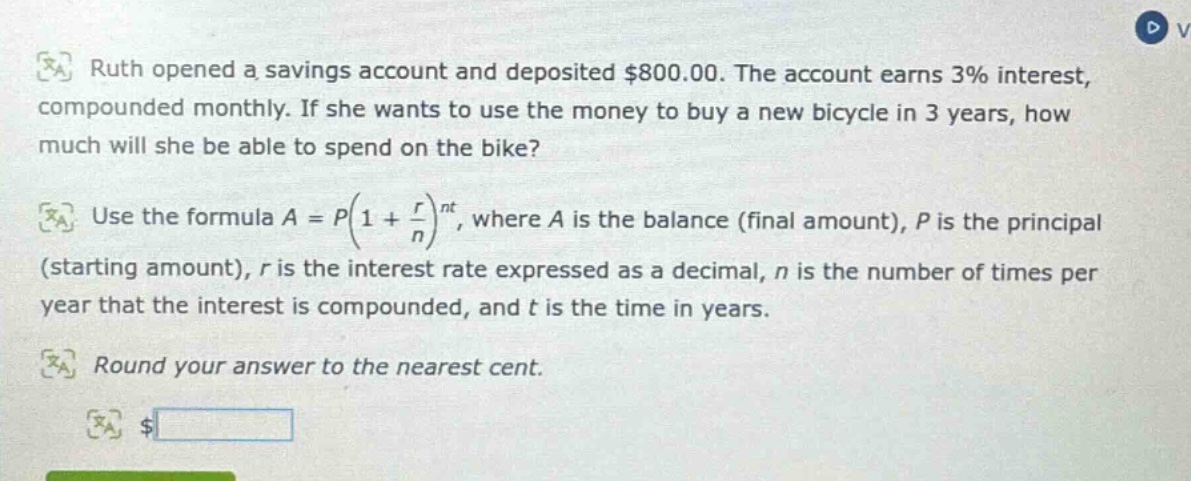
ruth opened a savings account and deposited $800.00. the account earns 3% interest, compounded monthly. if she wants to use the money to buy a new bicycle in 3 years, how much will she be able to spend on the bike? use the formula a = p(1 + r/n)^nt, where a is the balance (final amount), p is the principal (starting amount), r is the interest rate expressed as a decimal, n is the number of times per year that the interest is compounded, and t is the time in years. round your answer to the nearest cent. $
Answer
Explanation:
Step1: Identify the values
$P = 800$, $r=0.03$, $n = 12$, $t = 3$
Step2: Substitute values into formula
$A=800\left(1+\frac{0.03}{12}\right)^{12\times3}$
Step3: Calculate inside the parentheses
$1+\frac{0.03}{12}=1 + 0.0025=1.0025$
Step4: Calculate the exponent
$12\times3 = 36$
Step5: Calculate the power
$(1.0025)^{36}\approx1.094051$
Step6: Calculate the final amount
$A = 800\times1.094051\approx875.24$
Answer:
$875.24$