salim purchased a new car for $21,000, and it depreciates in value each year. the function y = 21,000(1…
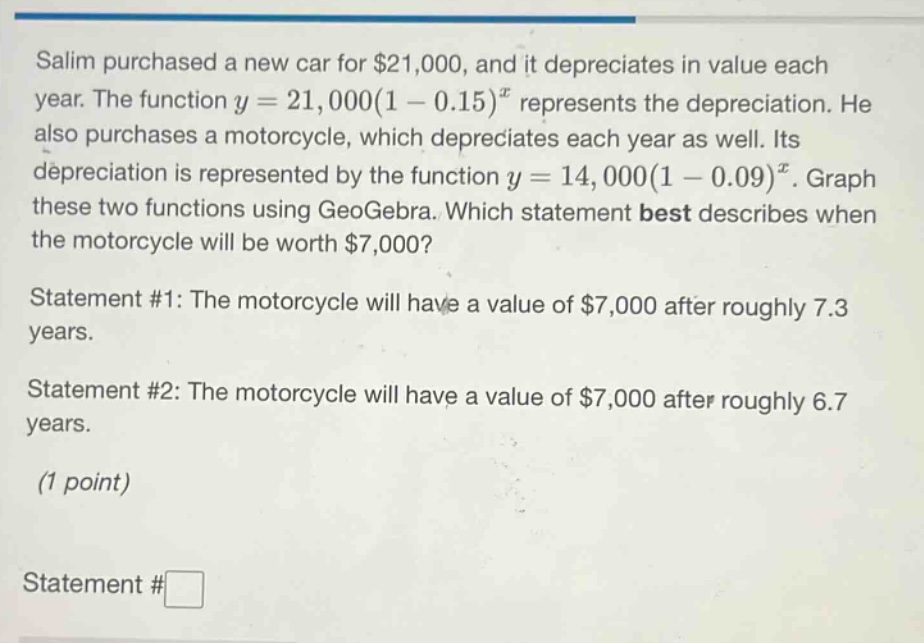
salim purchased a new car for $21,000, and it depreciates in value each year. the function y = 21,000(1 - 0.15)^x represents the depreciation. he also purchases a motorcycle, which depreciates each year as well. its depreciation is represented by the function y = 14,000(1 - 0.09)^x. graph these two functions using geogebra. which statement best describes when the motorcycle will be worth $7,000? statement #1: the motorcycle will have a value of $7,000 after roughly 7.3 years. statement #2: the motorcycle will have a value of $7,000 after roughly 6.7 years. (1 point) statement #
Answer
Explanation:
Step1: Set up the equation
We know the depreciation - function for the motorcycle is $y = 14000(1 - 0.09)^x$, and we want to find $x$ when $y = 7000$. So we set up the equation $7000=14000(1 - 0.09)^x$.
Step2: Simplify the equation
Divide both sides of the equation by $14000$: $\frac{7000}{14000}=(0.91)^x$, which simplifies to $0.5=(0.91)^x$.
Step3: Take the natural - logarithm of both sides
$\ln(0.5)=\ln((0.91)^x)$. Using the property of logarithms $\ln(a^b)=b\ln(a)$, we get $\ln(0.5)=x\ln(0.91)$.
Step4: Solve for $x$
$x=\frac{\ln(0.5)}{\ln(0.91)}\approx\frac{- 0.6931}{-0.0943}\approx7.35$.
Answer:
Statement #1