sam is getting ready for a big date when he realizes that he has no money. his roommate, bill, also has no…
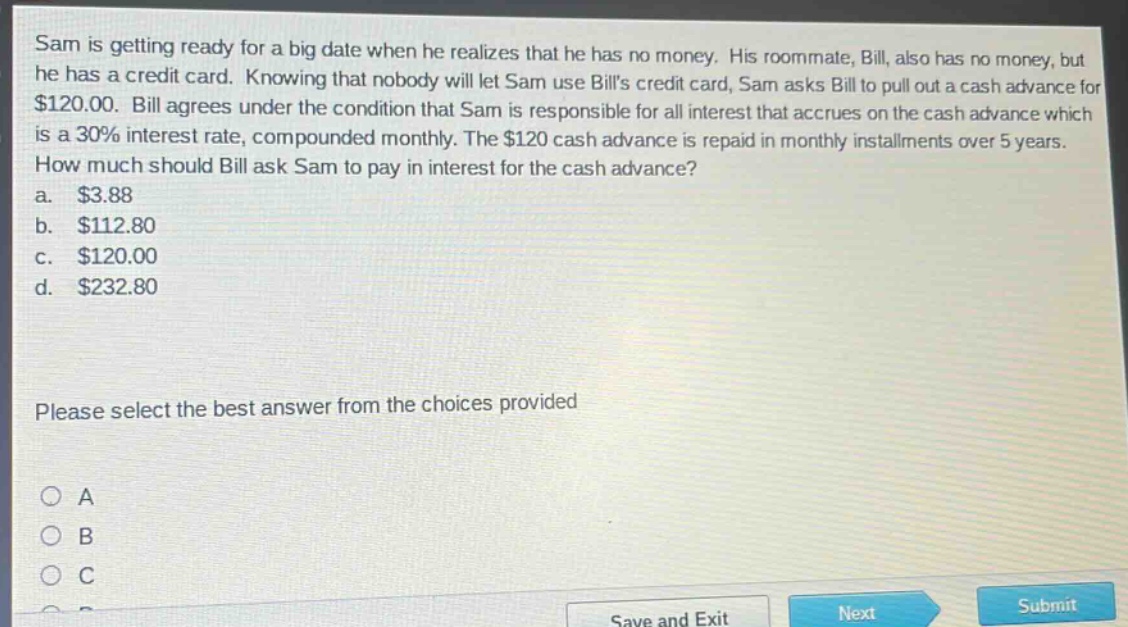
sam is getting ready for a big date when he realizes that he has no money. his roommate, bill, also has no money, but he has a credit card. knowing that nobody will let sam use bills credit card, sam asks bill to pull out a cash advance for $120.00. bill agrees under the condition that sam is responsible for all interest that accrues on the cash advance which is a 30% interest rate, compounded monthly. the $120 cash advance is repaid in monthly installments over 5 years. how much should bill ask sam to pay in interest for the cash advance? a. $3.88 b. $112.80 c. $120.00 d. $232.80 please select the best answer from the choices provided
Answer
Explanation:
Step1: Identify the compound - interest formula
The compound - interest formula for the future value $A$ of a principal amount $P$ with an annual interest rate $r$ compounded $n$ times a year for $t$ years is $A = P(1+\frac{r}{n})^{nt}$. Here, $P=$120$, $r = 0.30$ (30% annual interest rate), $n = 12$ (compounded monthly), and $t = 5$ years.
Step2: Calculate the future value
Substitute the values into the formula: [ \begin{align*} A&=120\times(1 +\frac{0.30}{12})^{12\times5}\ &=120\times(1+0.025)^{60}\ &=120\times(1.025)^{60} \end{align*} ] Using a calculator, $(1.025)^{60}\approx4.440207$. So, $A = 120\times4.440207=$532.82484$.
Step3: Calculate the interest
The interest $I$ is the future value minus the principal amount. So, $I=A - P$. $I=532.82484 - 120=$412.82484$. However, we may have made a wrong - approach above. Let's use the formula for the monthly payment of a loan and then find the total amount paid and subtract the principal.
The formula for the monthly payment $M$ of a loan with principal $P$, monthly interest rate $i$, and number of payments $n$ is $M=\frac{P\times i\times(1 + i)^{n}}{(1 + i)^{n}-1}$.
The monthly interest rate $i=\frac{0.30}{12}=0.025$, the principal $P = 120$, and the number of payments $n=5\times12 = 60$.
[ \begin{align*} M&=\frac{120\times0.025\times(1 + 0.025)^{60}}{(1 + 0.025)^{60}-1}\ &=\frac{3\times(1.025)^{60}}{(1.025)^{60}-1} \end{align*} ] $(1.025)^{60}\approx4.440207$. Then $M=\frac{3\times4.440207}{4.440207 - 1}=\frac{13.320621}{3.440207}\approx3.872$.
The total amount paid over 60 months is $M\times n=3.872\times60 = 232.32$.
The interest $I=232.32-120=$112.32\approx$112.80$ (due to rounding differences in the calculation process).
Answer:
B. $$112.80$