sam received a $1700 bonus. he decided to invest it in a 3 - year certificate of deposit (cd) with an annual…
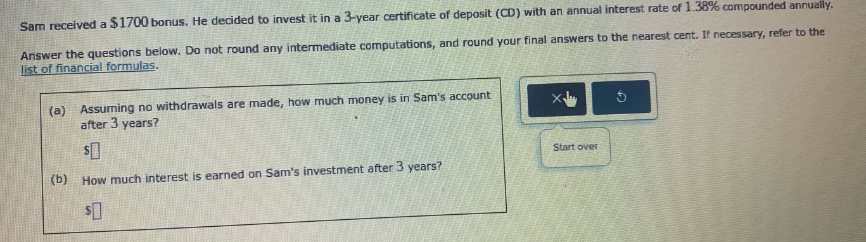
sam received a $1700 bonus. he decided to invest it in a 3 - year certificate of deposit (cd) with an annual interest rate of 1.38% compounded annually. answer the questions below. do not round any intermediate computations, and round your final answers to the nearest cent. if necessary, refer to the list of financial formulas. (a) assuming no withdrawals are made, how much money is in sams account after 3 years? $ (b) how much interest is earned on sams investment after 3 years? $
Answer
Explanation:
Step1: Identify the compound - interest formula
The compound - interest formula is $A = P(1 + r)^t$, where $A$ is the amount of money in the account after $t$ years, $P$ is the principal amount (initial investment), $r$ is the annual interest rate (in decimal form), and $t$ is the number of years. Here, $P=$1700$, $r = 0.0138$ (since $1.38%=0.0138$), and $t = 3$.
Step2: Calculate the amount in the account after 3 years
Substitute the values into the formula: $A=1700\times(1 + 0.0138)^3=1700\times(1.0138)^3$. First, calculate $(1.0138)^3=1.0138\times1.0138\times1.0138\approx1.04197$. Then, $A = 1700\times1.04197=$1771.35$.
Step3: Calculate the interest earned
The interest earned $I$ is the difference between the final amount $A$ and the principal $P$. So, $I=A - P$. We know $A\approx1771.35$ and $P = 1700$. Then $I=1771.35−1700=$71.35$.
Answer:
(a) $$1771.35$ (b) $$71.35$