sam takes a job with a starting salary of $50,000 for the first year. he earns a 4% increase each year…
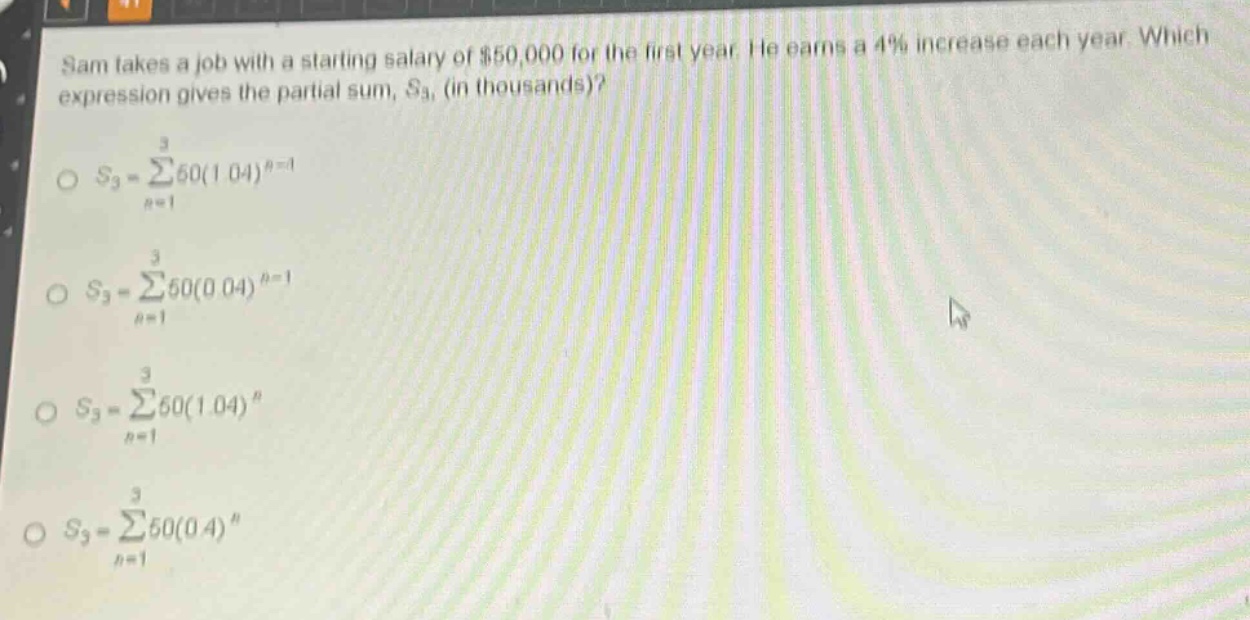
sam takes a job with a starting salary of $50,000 for the first year. he earns a 4% increase each year. which expression gives the partial sum, $s_3$, (in thousands)?\n$s_3=sum_{n = 1}^{3}50(1.04)^{n - 1}$\n$s_3=sum_{n = 1}^{3}50(0.04)^{n - 1}$\n$s_3=sum_{n = 1}^{3}50(1.04)^{n}$\n$s_3=sum_{n = 1}^{3}50(0.4)^{n}$
Answer
Explanation:
Step1: Identify the geometric - series formula
The salary forms a geometric series. The general formula for the (n) - th term of a geometric series is (a_n=a_1r^{n - 1}), where (a_1) is the first - term and (r) is the common ratio. Here, (a_1 = 50) (in thousands) and (r=1 + 0.04=1.04).
Step2: Recall the formula for the partial sum of a geometric series
The formula for the partial sum (S_n=\sum_{k = 1}^{n}a_1r^{k - 1}). For (n = 3), (a_1 = 50) and (r = 1.04), we have (S_3=\sum_{n = 1}^{3}50(1.04)^{n - 1}).
Answer:
(S_3=\sum_{n = 1}^{3}50(1.04)^{n - 1}) (the first option)