scenario #3: isaiah is in his 50s and currently does not have a retirement fund. however, he recently read a…
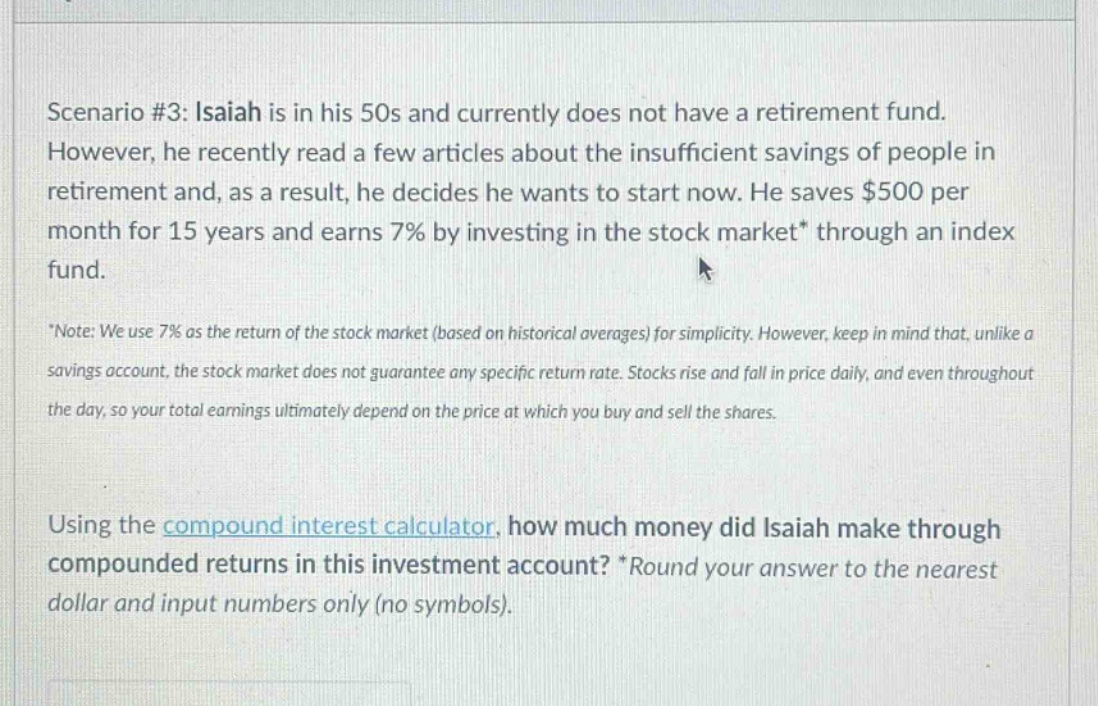
scenario #3: isaiah is in his 50s and currently does not have a retirement fund. however, he recently read a few articles about the insufficient savings of people in retirement and, as a result, he decides he wants to start now. he saves $500 per month for 15 years and earns 7% by investing in the stock market* through an index fund. *note: we use 7% as the return of the stock market (based on historical averages) for simplicity. however, keep in mind that, unlike a savings account, the stock market does not guarantee any specific return rate. stocks rise and fall in price daily, and even throughout the day, so your total earnings ultimately depend on the price at which you buy and sell the shares. using the compound interest calculator, how much money did isaiah make through compounded returns in this investment account? *round your answer to the nearest dollar and input numbers only (no symbols).
Answer
Explanation:
Step1: Identify the relevant formula
The formula for the future - value of an ordinary annuity is $FVA = P\times\frac{(1 + r)^{n}-1}{r}$, where $P$ is the payment per period, $r$ is the interest rate per period, and $n$ is the number of periods. Here, $P = 500$, the annual interest rate $i=7%=0.07$, so the monthly interest rate $r=\frac{0.07}{12}$, and the number of months $n = 15\times12=180$.
Step2: Calculate the future - value of the annuity
First, calculate $(1 + r)^{n}=(1+\frac{0.07}{12})^{180}$. Let $x=\frac{0.07}{12}\approx0.005833$. Then $(1 + x)^{180}\approx2.8318$. Next, $\frac{(1 + r)^{n}-1}{r}=\frac{2.8318 - 1}{0.005833}=\frac{1.8318}{0.005833}\approx314.04$. $FVA = 500\times314.04 = 157020$. The total amount of money he saved without interest is $500\times180 = 90000$.
Step3: Calculate the compounded returns
The compounded returns is $FVA-500\times180=157020 - 90000=67020$.
Answer:
67020