select the correct answer from each drop - down menu.\nthe finance department at a regional toy company has…
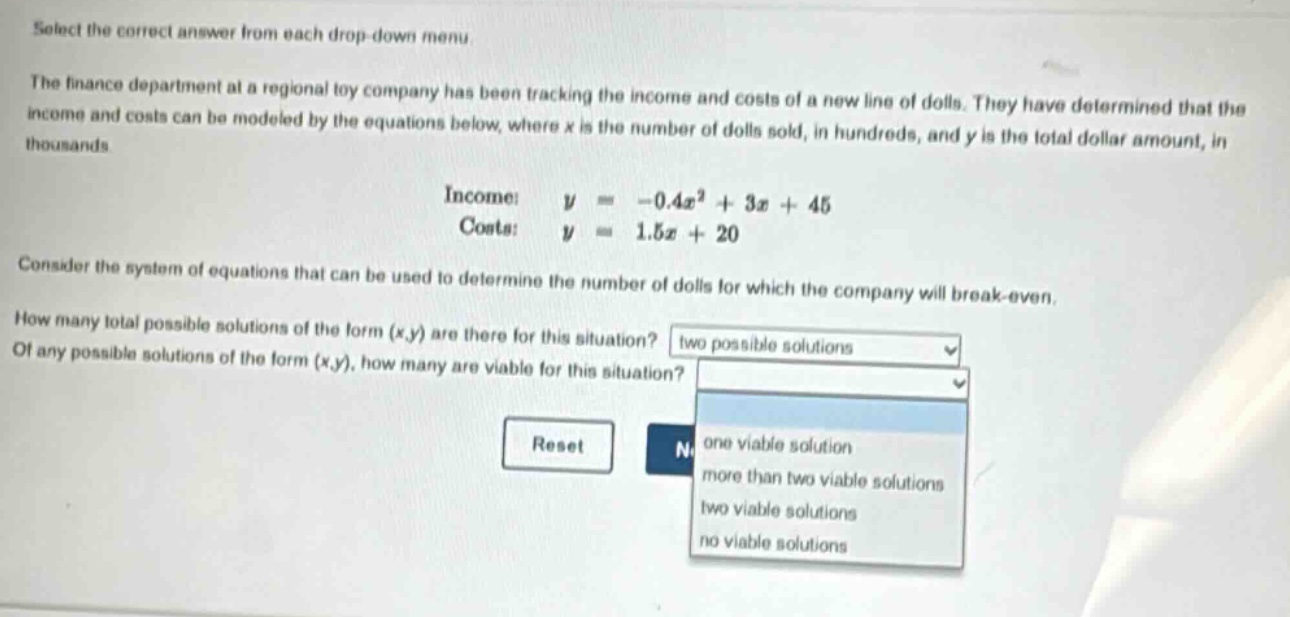
select the correct answer from each drop - down menu.\nthe finance department at a regional toy company has been tracking the income and costs of a new line of dolls. they have determined that the income and costs can be modeled by the equations below, where x is the number of dolls sold, in hundreds, and y is the total dollar amount, in thousands.\nincome: $y=-0.4x^{2}+3x + 45$\ncosts: $y = 1.5x+20$\nconsider the system of equations that can be used to determine the number of dolls for which the company will break - even.\nhow many total possible solutions of the form (x,y) are there for this situation?\nof any possible solutions of the form (x,y), how many are viable for this situation?
Answer
Answer:
- two possible solutions
- one viable solution
Explanation:
Step1: Set income equal to costs
$-0.4x^{2}+3x + 45=1.5x + 20$
Step2: Rearrange to quadratic form
$-0.4x^{2}+3x-1.5x + 45 - 20=0$ $-0.4x^{2}+1.5x + 25 = 0$
Step3: Use discriminant formula
For $ax^{2}+bx + c = 0$ ($a=-0.4$, $b = 1.5$, $c = 25$), the discriminant $\Delta=b^{2}-4ac$. $\Delta=(1.5)^{2}-4\times(-0.4)\times25=2.25 + 40=42.25>0$, so there are two possible solutions.
Step4: Consider viability
Since $x$ represents the number of dolls sold in hundreds and must be non - negative. Solving the quadratic equation $-0.4x^{2}+1.5x + 25 = 0$ using the quadratic formula $x=\frac{-b\pm\sqrt{\Delta}}{2a}=\frac{-1.5\pm\sqrt{42.25}}{2\times(-0.4)}$. One root is negative and one root is positive. So there is one viable solution (the non - negative root).