select the correct answer from each drop - down menu. maite has money in an interest - bearing account. the…
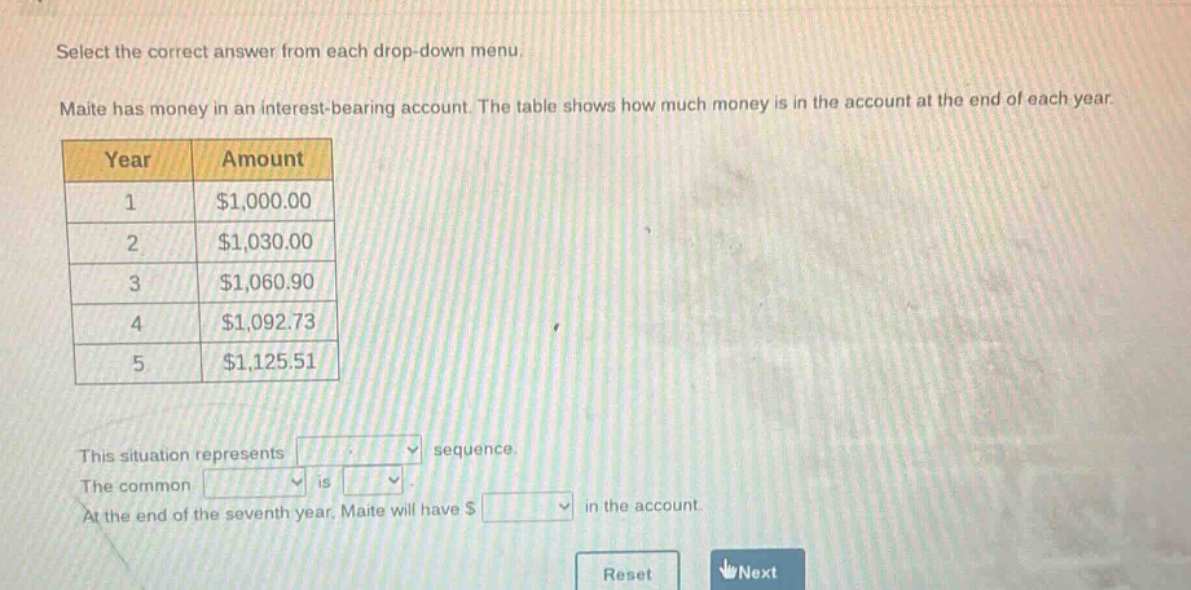
select the correct answer from each drop - down menu. maite has money in an interest - bearing account. the table shows how much money is in the account at the end of each year.\n| year | amount |\n| ---- | ---- |\n| 1 | $1,000.00 |\n| 2 | $1,030.00 |\n| 3 | $1,060.90 |\n| 4 | $1,092.73 |\n| 5 | $1,125.51 |\nthis situation represents sequence.\nthe common is.\nat the end of the seventh year, maite will have $ in the account.
Answer
Explanation:
Step1: Identify the sequence type
We check the ratio between consecutive terms. $\frac{1030}{1000}=1.03$, $\frac{1060.9}{1030}=1.03$, $\frac{1092.73}{1060.9}=1.03$, $\frac{1125.51}{1092.73}=1.03$. Since there is a common ratio between consecutive terms, it is a geometric sequence.
Step2: Determine the common ratio
As calculated above, the common ratio $r = 1.03$.
Step3: Find the amount at the 7th - year
The formula for the $n$th term of a geometric sequence is $a_n=a_1r^{n - 1}$, where $a_1 = 1000$, $r=1.03$, and $n = 7$. $a_7=1000\times(1.03)^{7 - 1}=1000\times(1.03)^6$. $(1.03)^6=1.03\times1.03\times1.03\times1.03\times1.03\times1.03\approx1.194052$. $a_7=1000\times1.194052 = 1194.052\approx1194.05$.
Answer:
This situation represents a geometric sequence. The common ratio is 1.03. At the end of the seventh year, Maite will have $1194.05$ in the account.