select the correct answer.\nfuture value = p × (1 + i)^t\npresent value = \\frac{p}{(1 + i)^t}\nif you save…
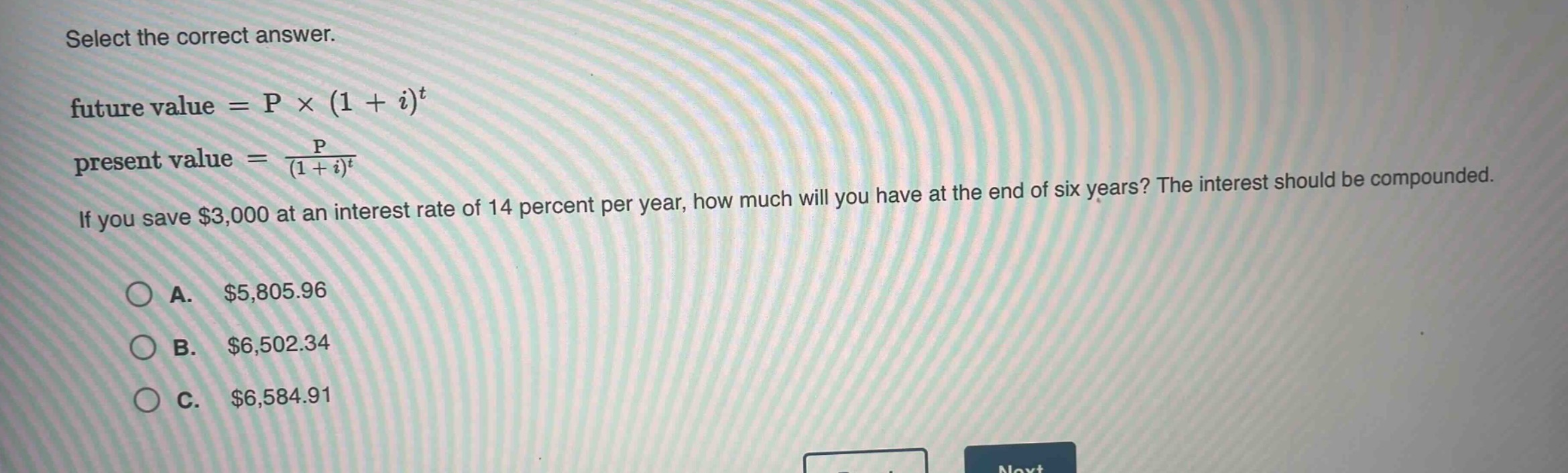
select the correct answer.\nfuture value = p × (1 + i)^t\npresent value = \\frac{p}{(1 + i)^t}\nif you save $3,000 at an interest rate of 14 percent per year, how much will you have at the end of six years? the interest should be compounded.\n\na. $5,805.96\nb. $6,502.34\nc. $6,584.91
Answer
Explanation:
Step1: Identify the formula and values
We use the future - value formula $FV = P\times(1 + i)^t$, where $P=$3000$, $i = 0.14$, and $t = 6$.
Step2: Substitute the values into the formula
$FV=3000\times(1 + 0.14)^6$. First, calculate $(1 + 0.14)^6=(1.14)^6$. $(1.14)^6=1.14\times1.14\times1.14\times1.14\times1.14\times1.14\approx2.194973$. Then, $FV = 3000\times2.194973=$6584.919\approx$6584.91$.
Answer:
C. $$6,584.91$