select the correct answer.\nstephanie belongs to a ppo that has a $1,000 deductible. the deductible applies…
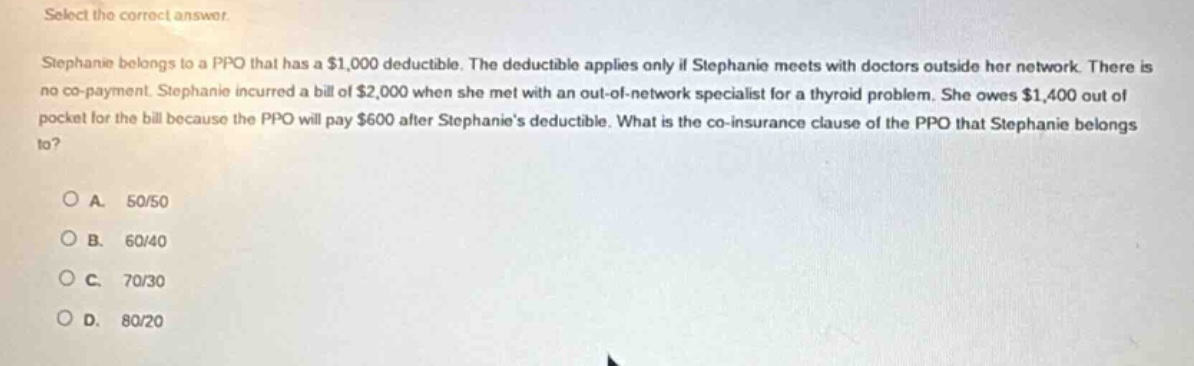
select the correct answer.\nstephanie belongs to a ppo that has a $1,000 deductible. the deductible applies only if stephanie meets with doctors outside her network. there is no co - payment. stephanie incurred a bill of $2,000 when she met with an out - of - network specialist for a thyroid problem. she owes $1,400 out of pocket for the bill because the ppo will pay $600 after stephanies deductible. what is the co - insurance clause of the ppo that stephanie belongs to?\n\na. 50/50\nb. 60/40\nc. 70/30\nd. 80/20
Answer
Explanation:
Step1: Calculate amount subject to coinsurance
The bill is $2000$ and the deductible is $1000$. So the amount subject to coinsurance is $2000 - 1000=1000$.
Step2: Calculate PPO's share of coinsurance amount
The PPO pays $600$ after the deductible. So the PPO's share of the $1000$ (amount subject to coinsurance) is $600$.
Step3: Calculate patient's share of coinsurance amount
The patient owes $1400$ out - of - pocket. After paying the $1000$ deductible, the patient's share of the $1000$ (amount subject to coinsurance) is $1400 - 1000 = 400$.
Step4: Determine coinsurance ratio
The PPO pays $600$ and the patient pays $400$ out of the $1000$ amount subject to coinsurance. So the coinsurance ratio is $60/40$.
Answer:
B. 60/40