select the correct answer.\nthe table shows the balance of an investment account at the beginning of each…
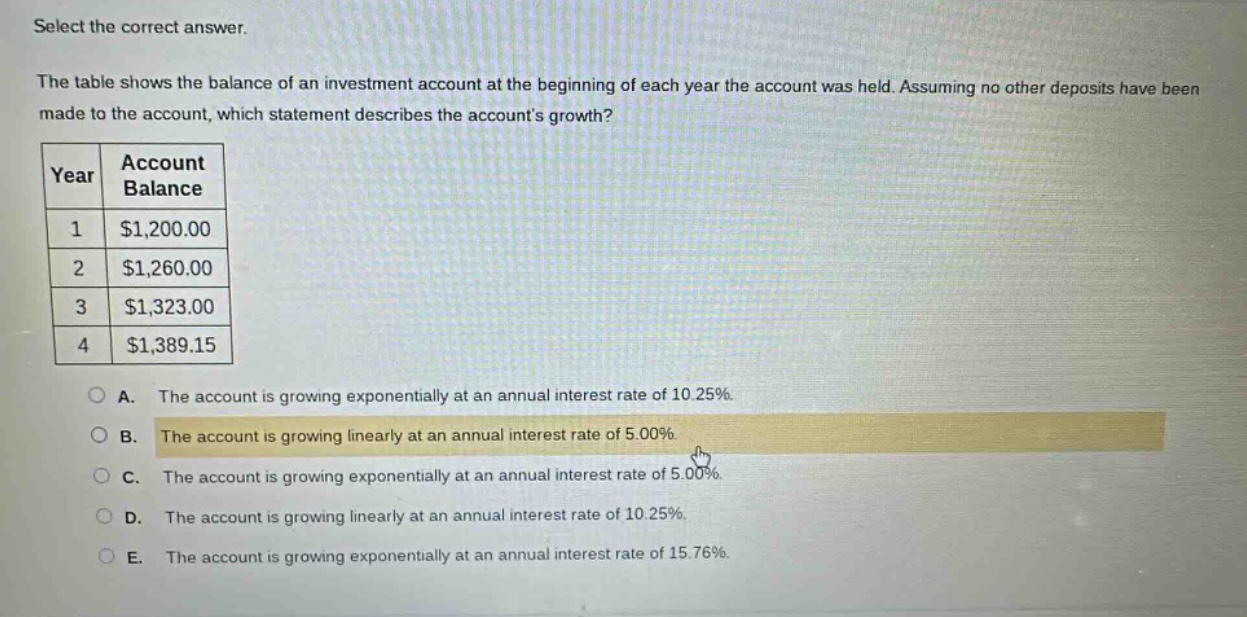
select the correct answer.\nthe table shows the balance of an investment account at the beginning of each year the account was held. assuming no other deposits have been made to the account, which statement describes the accounts growth?\n| year | account balance |\n| ---- | ---- |\n| 1 | $1,200.00 |\n| 2 | $1,260.00 |\n| 3 | $1,323.00 |\n| 4 | $1,389.15 |\na. the account is growing exponentially at an annual interest rate of 10.25%.\nb. the account is growing linearly at an annual interest rate of 5.00%.\nc. the account is growing exponentially at an annual interest rate of 5.00%.\nd. the account is growing linearly at an annual interest rate of 10.25%.\ne. the account is growing exponentially at an annual interest rate of 15.76%.
Answer
Explanation:
Step1: Check for exponential growth
For exponential growth, we use the formula $A = P(1 + r)^n$, where $A$ is the final amount, $P$ is the principal amount, $r$ is the annual interest rate and $n$ is the number of years. Let's check the ratio of consecutive account - balances. For year 1 to year 2: $\frac{1260}{1200}=1.05$. For year 2 to year 3: $\frac{1323}{1260} = 1.05$. For year 3 to year 4: $\frac{1389.15}{1323}=1.05$. Since the ratio of consecutive account - balances is constant ($1.05$), the growth is exponential.
Step2: Calculate the interest rate
If $A = P(1 + r)^n$ and the ratio of consecutive amounts is $1 + r$. Since the ratio is $1.05$, we can solve for $r$ in the equation $1 + r=1.05$. Subtracting 1 from both sides gives $r = 0.05$ or $5%$.
Answer:
C. The account is growing exponentially at an annual interest rate of 5.00%