3. before sending in your payment to the credit card company, you go to a bicycle store. how much can you…
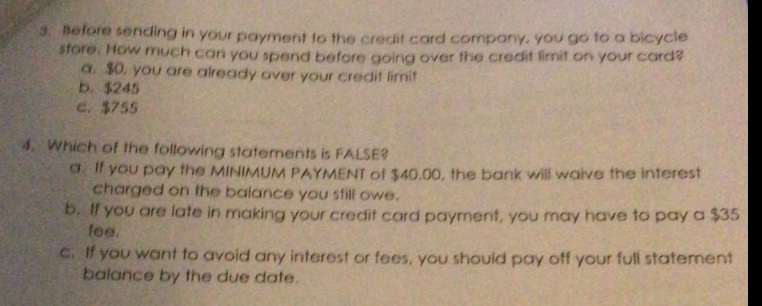
3. before sending in your payment to the credit card company, you go to a bicycle store. how much can you spend before going over the credit limit on your card? a. $0, you are already over your credit limit b. $245 c. $755 4. which of the following statements is false? a. if you pay the minimum payment of $40.00, the bank will waive the interest charged on the balance you still owe. b. if you are late in making your credit card payment, you may have to pay a $35 fee. c. if you want to avoid any interest or fees, you should pay off your full statement balance by the due date.
Answer
Explanation:
Step1: Analyze credit - card rules
Credit - card companies typically charge interest on the remaining balance even if the minimum payment is made.
Step2: Evaluate each option
Option a: Paying the minimum payment usually does not waive the interest on the remaining balance. This is a false statement. Option b: Late - payment fees are common in credit - card agreements, and a $35 fee is not unusual. This is a true statement. Option c: Paying off the full statement balance by the due date is the way to avoid interest and fees. This is a true statement.
Answer:
a. If you pay the MINIMUM PAYMENT of $40.00, the bank will waive the interest charged on the balance you still owe.