suppose that in 1696, a man bought a diamond worth the equivalent of $38. suppose that the man had instead…
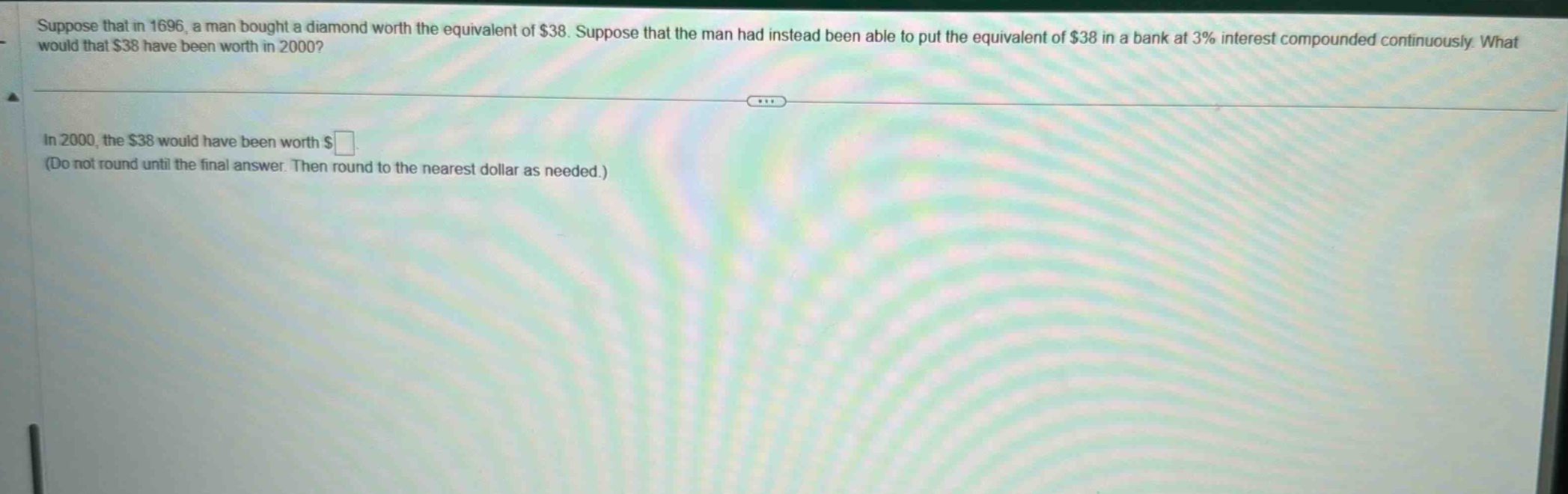
suppose that in 1696, a man bought a diamond worth the equivalent of $38. suppose that the man had instead been able to put the equivalent of $38 in a bank at 3% interest compounded continuously. what would that $38 have been worth in 2000? in 2000, the $38 would have been worth $ (do not round until the final answer. then round to the nearest dollar as needed.)
Answer
Explanation:
Step1: Determine the time - period
Calculate the number of years $t$ from 1696 to 2000. $t=2000 - 1696=304$ years.
Step2: Use the continuous - compounding formula
The formula for continuous compounding is $A = Pe^{rt}$, where $P$ is the principal amount, $r$ is the annual interest rate (in decimal form), and $t$ is the time in years. Here, $P = 38$, $r=0.03$, and $t = 304$. Substitute the values into the formula: $A=38\times e^{0.03\times304}$. First, calculate the exponent: $0.03\times304 = 9.12$. Then, find the value of $e^{9.12}$. Using a calculator, $e^{9.12}\approx9140.58$. Multiply by the principal: $A = 38\times9140.58=347342.04$.
Step3: Round the result
Round $347342.04$ to the nearest dollar. $A\approx347342$.
Answer:
347342