suppose that a family wants to start a college fund for their child. if they can get a rate of 5.5%…
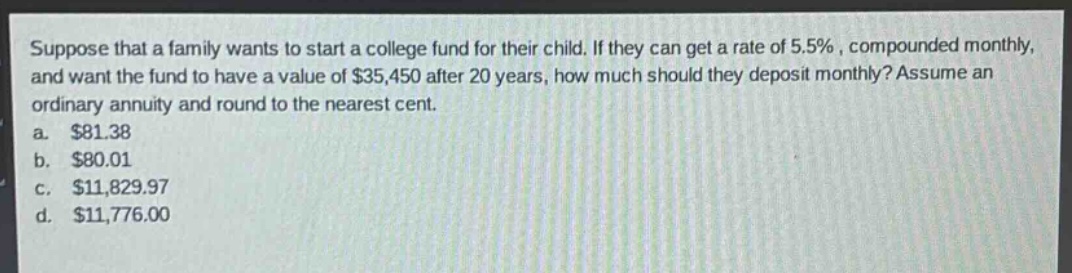
suppose that a family wants to start a college fund for their child. if they can get a rate of 5.5%, compounded monthly, and want the fund to have a value of $35,450 after 20 years, how much should they deposit monthly? assume an ordinary annuity and round to the nearest cent.\na. $81.38\nb. $80.01\nc. $11,829.97\nd. $11,776.00
Answer
Explanation:
Step1: Identify the formula for the future - value of an ordinary annuity
The formula for the future - value of an ordinary annuity is $F = A\times\frac{(1 + r)^{n}-1}{r}$, where $F$ is the future value of the annuity, $A$ is the amount of each payment, $r$ is the interest rate per period, and $n$ is the number of periods. The annual interest rate $i = 5.5%=0.055$. Since it is compounded monthly, the interest rate per month $r=\frac{0.055}{12}$. The number of years $t = 20$ years, and the number of months $n=20\times12 = 240$ months, and $F = 35450$. We need to solve the formula for $A$: [A=\frac{F\times r}{(1 + r)^{n}-1}]
Step2: Substitute the values into the formula
First, calculate $r=\frac{0.055}{12}\approx0.0045833$. Then, calculate $(1 + r)^{n}=(1 + 0.0045833)^{240}$. Using a calculator, $(1 + 0.0045833)^{240}\approx3.0067$. Now, substitute $F = 35450$, $r=0.0045833$, and $(1 + r)^{n}\approx3.0067$ into the formula for $A$: [A=\frac{35450\times0.0045833}{3.0067 - 1}] [A=\frac{162.477}{2.0067}] [A\approx81.38]
Answer:
a. $$81.38$