suppose that you deposit 700 dollars each month into a savings account that earns 2 percent interest per…
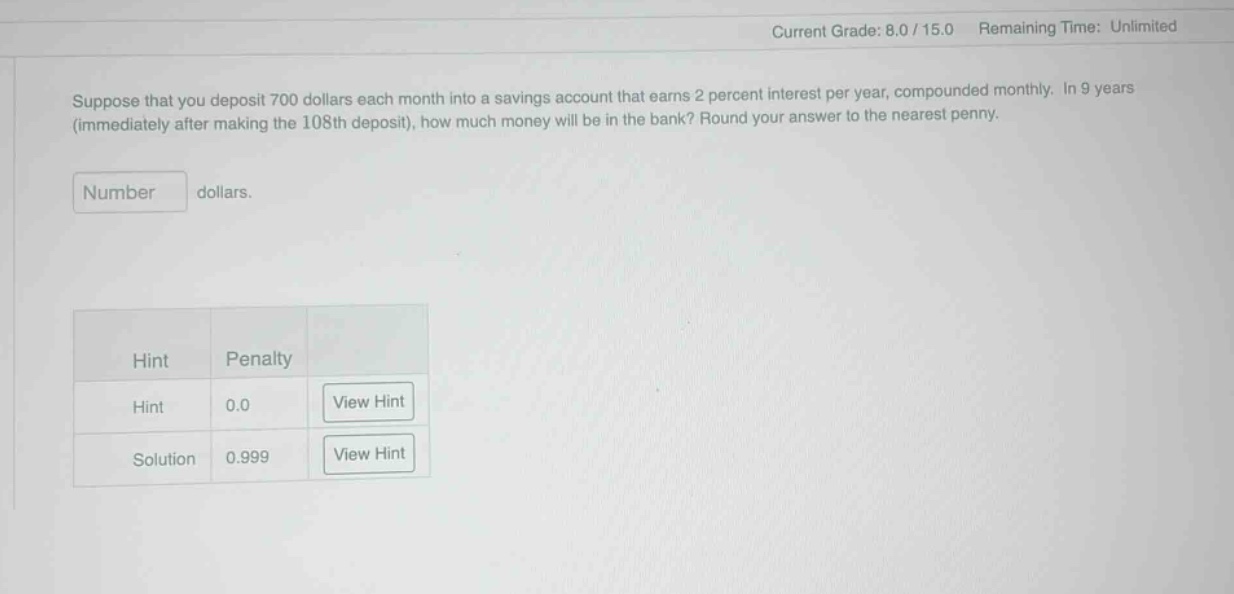
suppose that you deposit 700 dollars each month into a savings account that earns 2 percent interest per year, compounded monthly. in 9 years (immediately after making the 108th deposit), how much money will be in the bank? round your answer to the nearest penny. number dollars. hint penalty hint 0.0 view hint solution 0.999 view hint
Answer
Answer:
$87347.43$
Explanation:
Step1: Identify the relevant formula
The future - value of an ordinary annuity formula is $F = A\times\frac{(1 + r)^{n}-1}{r}$, where $A$ is the annuity payment, $r$ is the interest rate per period, and $n$ is the number of periods.
Step2: Calculate the interest rate per period
The annual interest rate $i = 2%=0.02$. Since it is compounded monthly, the interest rate per month $r=\frac{0.02}{12}$.
Step3: Determine the number of periods
The time is 9 years, and since there are 12 months in a year, the number of periods $n = 9\times12=108$. The annuity payment $A = 700$.
Step4: Substitute values into the formula
$F=700\times\frac{(1+\frac{0.02}{12})^{108}-1}{\frac{0.02}{12}}$. First, calculate $(1+\frac{0.02}{12})^{108}$. Let $x=\frac{0.02}{12}\approx0.001667$, then $(1 + x)^{108}=(1 + 0.001667)^{108}$. Using the formula $(a + b)^n=\sum_{k = 0}^{n}\binom{n}{k}a^{n - k}b^{k}$, or simply using a calculator, $(1+0.001667)^{108}\approx1.190677$. Then, $(1+\frac{0.02}{12})^{108}-1\approx1.190677 - 1=0.190677$. $\frac{(1+\frac{0.02}{12})^{108}-1}{\frac{0.02}{12}}=\frac{0.190677}{\frac{0.02}{12}}=\frac{0.190677\times12}{0.02}=114.4062$. Finally, $F = 700\times114.4062=87347.43$.