the table below shows the future value of a certificate of deposit (cd), after x years. eric states the…
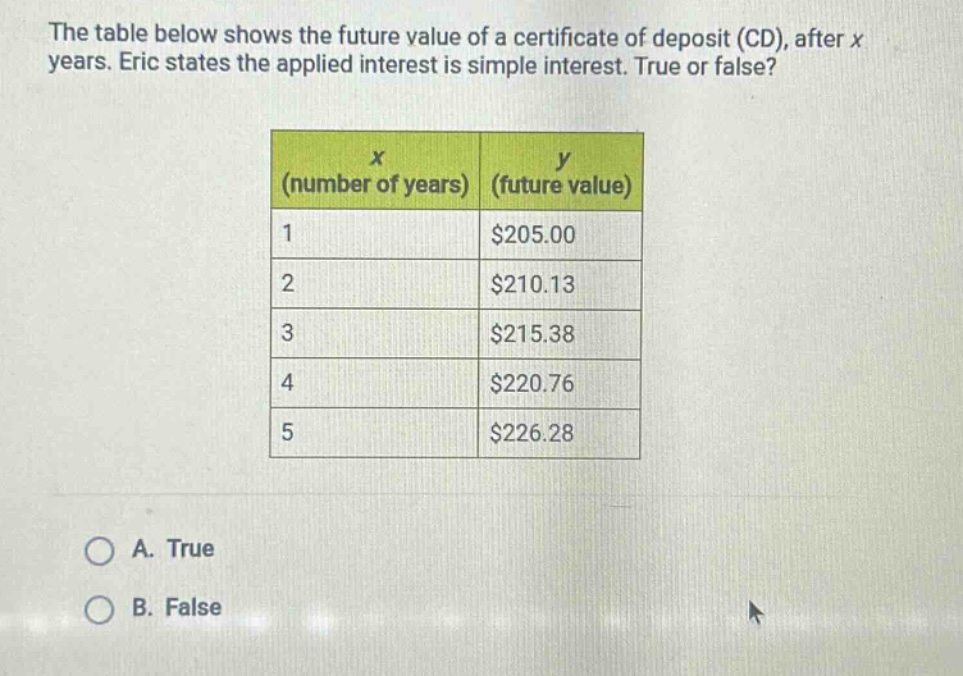
the table below shows the future value of a certificate of deposit (cd), after x years. eric states the applied interest is simple interest. true or false?\n|x (number of years)|y (future value)|\n|----|----|\n|1|$205.00|\n|2|$210.13|\n|3|$215.38|\n|4|$220.76|\n|5|$226.28|\na. true\nb. false
Answer
Explanation:
Step1: Recall simple - interest formula
The formula for simple interest is $A = P(1+rt)$, where $A$ is the future value, $P$ is the principal, $r$ is the interest rate, and $t$ is the time. In a simple - interest scenario, the change in the future value over equal time intervals is constant.
Step2: Calculate differences in future values
For $x = 1$ to $x = 2$: $210.13−205.00 = 5.13$. For $x = 2$ to $x = 3$: $215.38−210.13 = 5.25$. For $x = 3$ to $x = 4$: $220.76−215.38 = 5.38$. For $x = 4$ to $x = 5$: $226.28−220.76 = 5.52$.
Step3: Analyze the differences
Since the differences in the future values between consecutive years are not constant, the interest is not simple interest.
Answer:
B. False