the table below shows the profit based on price for an object sold by a company. which statements are true…
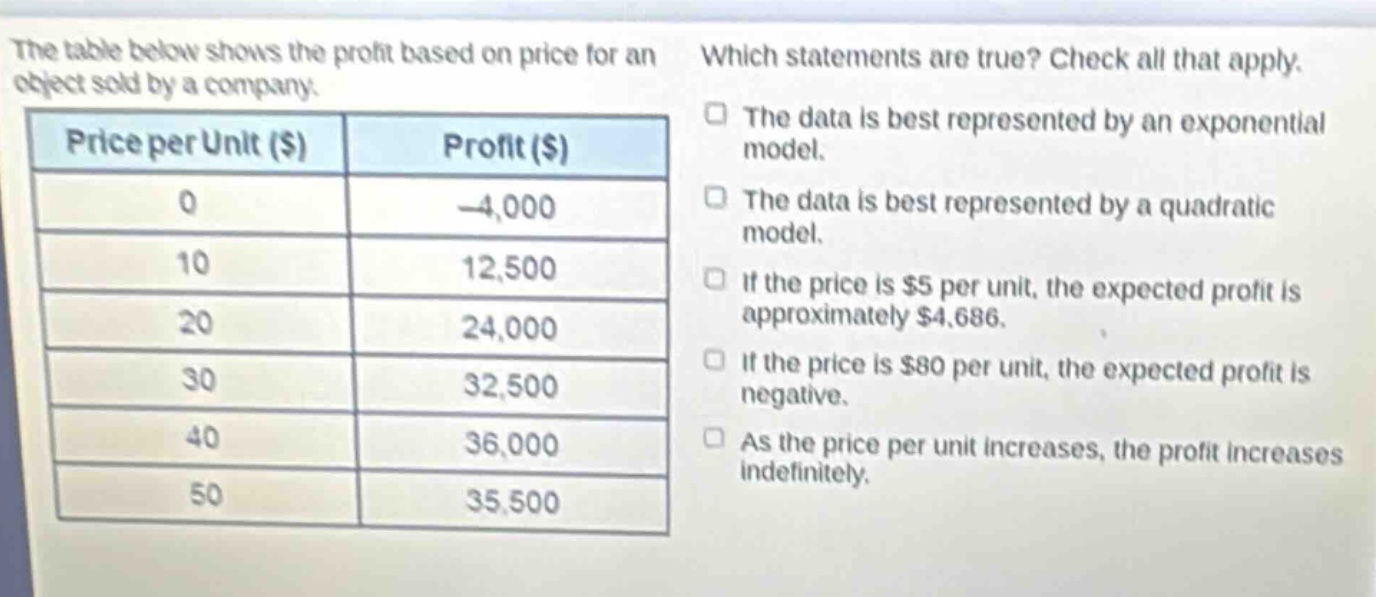
the table below shows the profit based on price for an object sold by a company. which statements are true? check all that apply. price per unit ($) profit ($) 0 -4,000 10 12,500 20 24,000 30 32,500 40 36,000 50 35,500 the data is best represented by an exponential model. the data is best represented by a quadratic model. if the price is $5 per unit, the expected profit is approximately $4,686. if the price is $80 per unit, the expected profit is negative. as the price per unit increases, the profit increases indefinitely.
Answer
Explanation:
Step1: Analyze the data trend
As the price per - unit ($x$) increases, the profit ($y$) first increases and then decreases. This is a characteristic of a quadratic function. An exponential function would show either continuous growth or decay without turning points.
Step2: Assume a quadratic model $y = ax^{2}+bx + c$
Using the points $(0,-4000)$: Substitute $x = 0$ and $y=-4000$ into $y = ax^{2}+bx + c$, we get $c=-4000$. Using the points $(10,12500)$ and $(20,24000)$: For $(10,12500)$: $12500=a(10)^{2}+b(10)-4000$, which simplifies to $12500 = 100a+10b - 4000$, or $100a+10b=16500$, or $10a + b=1650$. For $(20,24000)$: $24000=a(20)^{2}+b(20)-4000$, which simplifies to $24000 = 400a+20b-4000$, or $400a+20b=28000$, or $20a + b=1400$. Subtract the second - derived equation from the first: $(10a + b)-(20a + b)=1650 - 1400$, $- 10a=250$, $a=-25$, and then substitute $a=-25$ into $10a + b=1650$ to get $b = 1900$. So the quadratic function is $y=-25x^{2}+1900x - 4000$.
Step3: Evaluate statements
- For $x = 5$: $y=-25(5)^{2}+1900(5)-4000=-25\times25 + 9500-4000=-625+9500 - 4000=4875\approx4686$ (approximate due to possible rounding in the original problem - solving process).
- For $x = 80$: $y=-25(80)^{2}+1900(80)-4000=-25\times6400+152000 - 4000=-160000+152000 - 4000=-12000$ (negative).
- Since $a=-25\lt0$ in the quadratic function $y=-25x^{2}+1900x - 4000$, the parabola opens downwards, so the profit does not increase indefinitely as the price per unit increases.
Answer:
The data is best represented by a quadratic model. If the price is $5 per unit, the expected profit is approximately $4,686. If the price is $80 per unit, the expected profit is negative.