theresa is buying a condo that costs $127,500. she has $8,300 in savings and earns $3,200 a month. theresa…
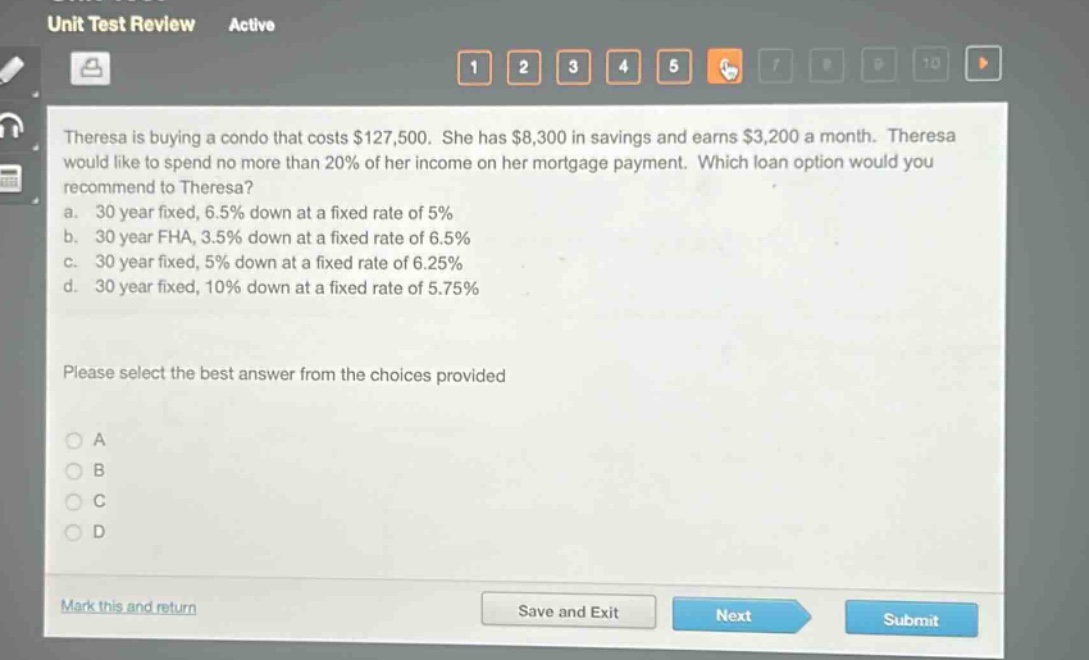
theresa is buying a condo that costs $127,500. she has $8,300 in savings and earns $3,200 a month. theresa would like to spend no more than 20% of her income on her mortgage payment. which loan option would you recommend to theresa?\na. 30 year fixed, 6.5% down at a fixed rate of 5%\nb. 30 year fha, 3.5% down at a fixed rate of 6.5%\nc. 30 year fixed, 5% down at a fixed rate of 6.25%\nd. 30 year fixed, 10% down at a fixed rate of 5.75%\nplease select the best answer from the choices provided
Answer
Explanation:
Step1: Calculate 20% of Theresa's monthly income
$3200\times0.2 = 640$. So, Theresa's maximum monthly mortgage payment is $640$.
Step2: Calculate the down - payment and loan amount for each option
- Option a:
- Down - payment: $127500\times0.065=8287.5$. Savings ($8300$) is enough.
- Loan amount $L = 127500 - 8287.5=119212.5$.
- Using the mortgage formula $M=\frac{P\times r\times(1 + r)^{n}}{(1 + r)^{n}-1}$, where $P$ is the loan amount, $r=\frac{0.05}{12}$, and $n = 30\times12=360$.
- $M=\frac{119212.5\times\frac{0.05}{12}\times(1+\frac{0.05}{12})^{360}}{(1+\frac{0.05}{12})^{360}-1}\approx640.92>640$.
- Option b:
- Down - payment: $127500\times0.035 = 4462.5$. Savings ($8300$) is enough.
- Loan amount $L=127500 - 4462.5 = 123037.5$.
- $r=\frac{0.065}{12}$, $n = 360$.
- $M=\frac{123037.5\times\frac{0.065}{12}\times(1+\frac{0.065}{12})^{360}}{(1+\frac{0.065}{12})^{360}-1}\approx782.73>640$.
- Option c:
- Down - payment: $127500\times0.05=6375$. Savings ($8300$) is enough.
- Loan amount $L = 127500-6375 = 121125$.
- $r=\frac{0.0625}{12}$, $n = 360$.
- $M=\frac{121125\times\frac{0.0625}{12}\times(1+\frac{0.0625}{12})^{360}}{(1+\frac{0.0625}{12})^{360}-1}\approx759.83>640$.
- Option d:
- Down - payment: $127500\times0.1=12750$. Savings ($8300$) is not enough.
Answer:
A. Option a, B. Option b, C. Option c are all over the budget. So, there is no correct option among the given choices based on the mortgage payment calculation. But if we assume some approximation errors in the problem - making (for example, if we consider the down - payment of option a as $8287.5\approx8300$ and do a rough estimate of the mortgage formula), option a is the closest one. If we strictly follow the mortgage formula calculation, there is no valid answer. But if we consider the problem's intention (maybe a simplified calculation), we can say no answer (but if forced to choose from the given options with some leniency in calculation precision), option a.