use pmt = p(r/n)/1 - (1 + r/n)^(-nt) to determine the regular payment amount, rounded to the nearest dollar…
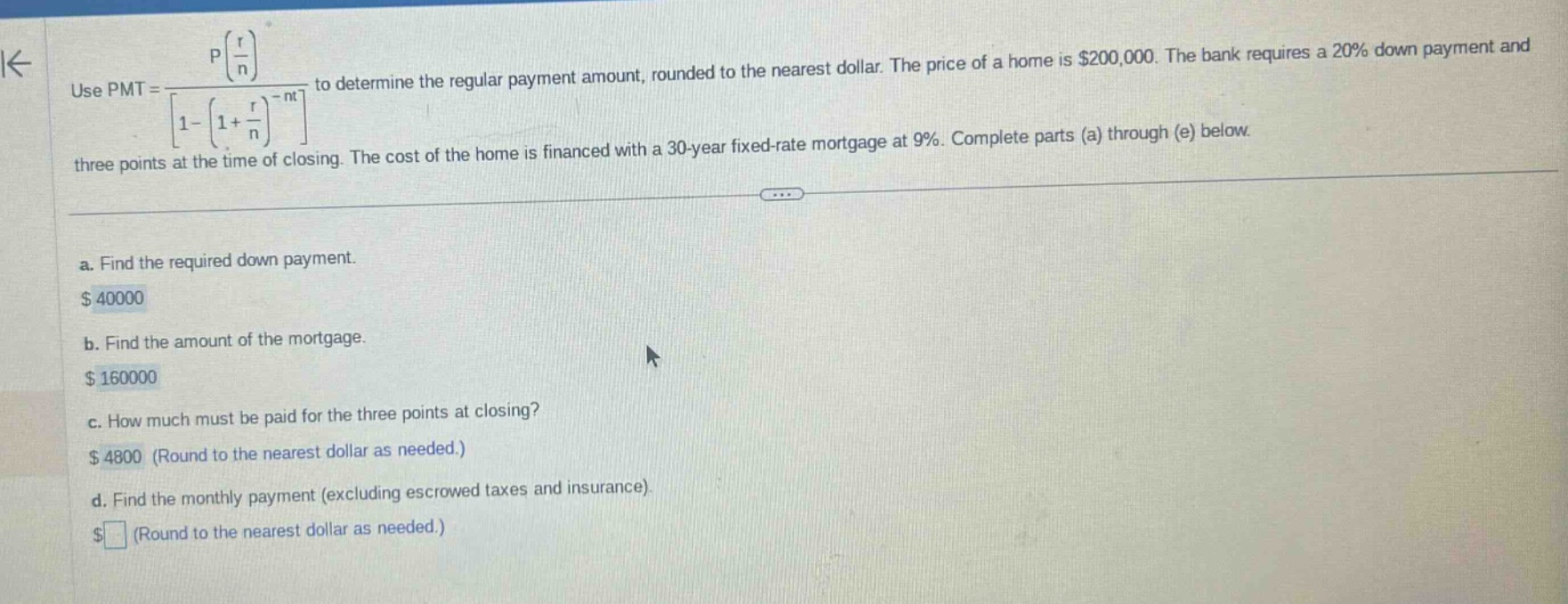
use pmt = p(r/n)/1 - (1 + r/n)^(-nt) to determine the regular payment amount, rounded to the nearest dollar. the price of a home is $200,000. the bank requires a 20% down payment and three points at the time of closing. the cost of the home is financed with a 30 - year fixed - rate mortgage at 9%. complete parts (a) through (e) below. a. find the required down payment. $40000 b. find the amount of the mortgage. $160000 c. how much must be paid for the three points at closing? $4800 (round to the nearest dollar as needed.) d. find the monthly payment (excluding escrowed taxes and insurance). $ (round to the nearest dollar as needed.)
Answer
Explanation:
Step1: Identify the values
The mortgage amount $P = 160000$, the annual interest rate $r=0.09$, the number of payments per year $n = 12$, and the number of years $t = 30$.
Step2: Calculate the exponent
$nt=12\times30 = 360$.
Step3: Calculate the interest rate per - period
$\frac{r}{n}=\frac{0.09}{12}=0.0075$.
Step4: Calculate the denominator
$1-(1 +\frac{r}{n})^{-nt}=1-(1 + 0.0075)^{-360}$. Let $x=(1 + 0.0075)^{-360}=\frac{1}{(1.0075)^{360}}$. Using a calculator, $(1.0075)^{360}\approx13.266777$, so $x=\frac{1}{13.266777}\approx0.07537$. Then $1-(1 + 0.0075)^{-360}=1 - 0.07537=0.92463$.
Step5: Calculate the numerator
$P\times\frac{r}{n}=160000\times0.0075 = 1200$.
Step6: Calculate the monthly payment
$PMT=\frac{P\times\frac{r}{n}}{1-(1+\frac{r}{n})^{-nt}}=\frac{1200}{0.92463}\approx1298$.
Answer:
$1298$